Showing posts with label Joseph Stiglitz. Show all posts

Financial Reform: the Train That Passed Us By

June 24
Stan G. Duncan

The house and Senate have finally passed their legislation on financial reform and now the two bills are in the “reconciliation process. “ That’s where they hammer out the differences and produce a single bill that both houses will then have to pass. Some changes may be made, but we’re pretty clear by now what will be in the final bill and it isn’t pretty. All of you who were hoping that finally we had a tragedy large enough for government to act like adults and pass some meaningful reform will be disappointed.

What’s in it?


Here’s a run-through of some of the things in the new legislation:

First it calls for Banks to have more capital on hand to borrow against when making investments. It’s like when you borrow money for a house, the bank wants to know how much of your own money you have to put down. Similarly, banks should have a big stash of cash on hand when they borrow money in case the deal goes bad and they have to cover some of it with their own money. So the new bill requires that they have something in the range of 10 to 12 percent of what they are borrowing before they borrow. The good news is that they will now be required to have it. The bad news is that most economists have been recommending around twenty to thirty percent. Twelve percent collateral is what Lehman Brothers had on hand when it bellied up a couple of years ago. It’s a paltry, almost humorously small amount of collateral.

Second, it calls for stronger oversight of derivatives, especially “credit default swaps,” which have been described as essentially bets against the success of a business transaction. If two companies hook some kind of deal, other companies who are unrelated to the transaction can make bets on its success. If too many bets are made against it, it begins to look weak and investors will start pulling their money out and both the transaction and the company can go under. And all of the bystanders who made the bets on its failure get paid. Credit Default Swaps were one of the most insidious of the tools that nearly took down Wall Street and the world in 2008. So a new provision in the law, drawn up primarily by Sen. Blanche Lincoln of Arkansas is a good thing.
However, the Wall Street lobby monster has become a major player in the negotiations and at present liberals, conservatives, Republicans, and Democrats have been working very hard to “compromise” the provision down. And the Treasury and Obama Administration has shown no interest in tightening or enforcing the existing regulations against derivatives. God only knows why, but I have my suspicions.[1]

Third, the bill calls for “More transparency and disclosure.” Transparency is always good. It’s a common piece put in this kind of legislation. But it seldom does much in practice. There were clear rules for transparency put into the new regulations for corporate disclosure following the horrible Enron scandal of the early 2000s, but all it mean was that the Annual Reports disclosed the obscure, arcane, Byzantine deals and swindles in even denser language and smaller print.

What is not in it?


Missing from the bill are new anti-trust tools or strengthening of the old ones. And at this point the reconciliation conference looks likely to deny them the self-funding. The Commodity Futures Trading Commission (CFTC) and the Federal Deposit Insurance Commission (FDIC), for example, both collect a portion of their fees from the industry they should be regulating.

Another missing piece is any way for “winding down large global firms” (a line included in the bill). There is language in the bill saying this should happen, but no mechanism to make it a reality. Just how, exactly will the President or the US trade Representative go to Spain, whose Santander Bank just bought up the U.S. Sovereign Bank and say they ought to shrink the company. Actually there are ways that we could do that by capping the size of banks, splitting them up, and making smaller banks. Caps could also be placed on the size that foreign owners could expand their holdings here. That would address the “Too Big to Fail” problem. There’s something inherently unhealthy about the wealth of four or five firms on Wall Street being larger than the Gross Domestic Product of thirty or forty countries in the world. Senators Sherrod Brown and Ted Kaufman pulled yeo-person’s duty trying to get a mechanism for breaking up the behemoth banks, but the Treasury and White House pushed against them and ultimately language for the change was removed.[2]

The “BP Clause”: Finally, there’s provision the White House asked for that sounds eerily like it was designed with the BP disaster in the backs of their minds. According to economist Simon Johnson at MIT, the bill includes “principles for the financial sector to make a fair and substantial contribution towards paying for any burdens.”[3] That provision is absurd. I’m not convinced that BP will in the long run be able to make a “substantial contribution” to paying of the cataclysmic tragedy that is unfolding in the gulf. It would have been even more impossible—fundamentally impossible—for Wall Street financial institutions to have socked enough money aside to pay off the damage they have done to every country on the planet. Countries large, small, and middle stumbled; companies, families, farms, individuals everywhere were damaged. Schools, libraries, clinics, were closed in every country. Churches—who were often very precarious before—are failing now at an unprecedented rate. With their members out of work or living on reduced pay, their pledges have shrunk. In turn, they can’t make their donations to Seminaries and they are bleeding or closing. Many are merging to stay alive just a little while longer. What will all of this mean for the future of the church and theological education for our children? World Hunger organizations also, who were for generations a major recipient of donations from churches, are also closing, merging, or shrinking. Think how many people in poor countries will be damaged by the loss. The “straight up” cost of the global destruction meted out by Wall Street activities has been estimated at somewhere around twenty trillion dollars.[4] The “collateral” damage to the innocent bystanders near and far is inestimable. The planet and its culture, climate, and heritage, will never be the same. It will take generations to pull ourselves back up to the level we were just pushed down from. And that’s assuming we have sufficient renewable energy to do so.

So, just what, exactly, does the president have in mind when he says that Wall Street is going to make a “substantial contribution” toward fixing the damage done? It can’t be done. He is dreaming if he believes that.

Why is the White House so reserved about meaningful reform and why is it so deferential to the Wall Street tycoons who plundered your grandmother’s pension for their billion dollar incomes? My guess has always been that Obama made a big mistake in the early parts of his administration and populated it with economists of the right who love--or even worked in--Wall Street. People like Robert Rubin-Former Treasury Secretary (1995-1999), Gene Sperling-Former National Economic Adviser (1997-2001), Lawrence Summers-Former Treasury Secretary (1999-2001) (and fired Harvard president). And he left out well known and respected progressives like Dean Baker at the Center for Economic and Policy Research, Jared Bernstein of the Economic Policy Institute (and now economic advisor to Vise President Joe Biden), Robert Reich former labor secretary (1992-1996), now at Berkeley, Paul Krugman at Princeton, Joe Stiglitz at Columbia, or Simon Johnson at MIT, Dani Rodrik at Harvard, Robert Shiller at Yale, Edie Rasell at the UCC, and so on. There is no clear, articulate voice in his cabinet (except for Joe Biden) who speaks for Main Street and I think that that has had a major impact on policy decisions. And it may leave its impact on the nation and the globe for as long as we all will live. 

Frankly, it may be too late. The financial reform train may have left the station. The Wall Street firms that survived are stronger than ever, smug in their power, and newly armed with a Supreme Court decision saying they can spend more money than God to buy and sell politicians to do their bidding. And you and I will have to just adjust to a new diminished democracy and living standard, with an ever stronger oligarchy running our country.

Some organizations have launched campaigns to get key Senators and Representatives to stand up for the values of the American public (not to mention those of the equally damaged international community), and make major changes in the reconciled bill. One of the more significant is Public Citizen, a forty-year-old corporate watchdog group. Click here to go to their "Strengthen Wall Street Reform" page and send a letter to your representatives.
 
Do it now. If it doesn't happen now, it may be too late.


[1] “A.I.G., Greece, and Who’s Next?” The New York Times, March 4, 2010, p. A 26.
[2] Interview with Sen. Ted Kaufman, The American Prospect, April 30, 2010, web edition: www.prospect.org/cs/articles?article=tap_talks_financial_reform_with_ted_kaufman.
[3]http://baselinescenario.com/2010/06/21/dead-on-arrival-financial-reform-fails/?utm_source=feedburner&utm_medium=email&utm_campaign=Feed%3A+BaselineScenario+%28The+Baseline+Scenario%29
[4] A good survey of the costs of the destructive force of Wall Street gambling is Anup Shah’s “Global Financial Crisis” page. It’s a year or so old, but still good for background, http://www.globalissues.org/article/768/global-financial-crisis

Implications of the Census Bureau’s Poverty Report

by Stan Duncan...


The Census Bureau’s annual poverty statistics came out last week and the numbers were ugly. Not only were they (1) uglier than we had hoped, it turns out they are (2) even worse than the Bureau says they are, and (3) they may stay ugly for generations to come.

This week’s blog is a long one because it’s a long subject. If you want to read it, but don’t have much time, read a chunk of two, go drink coffee, and come back later and pick it up. I won’t be offended.

So, let’s take a look at the report.

First, the numbers were uglier than people had hoped.[1]

If you don’t have much time, you have my permission to press print, write the words “bleak” over this section, and then move on to the next.

· Poverty [Incidentally, as a rule of thumb, the government defines poverty as an annual income of $22,025 for a family of four, $17,163 for a family of three and $14,051 for a family of two.]

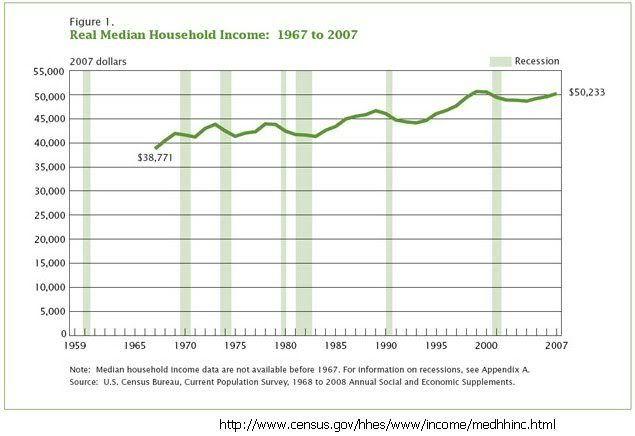
* Real median income declined by $1,860 from 2007 to 2008, a decline of 3.6%, the highest one-year decline in income on record.
* General poverty reached 13.2% in 2008, up from 12.5% in 2007 (and projected to be around 14% for 2009), which is its highest level in 11 years. This increase is because so much of our anti-poverty policies today are for paid work, and the so-called, “safety net” has been cut so much that it no longer does much when the job market is bupkis.
* The family poverty rate rose to 10.3 percent in 2008, up from 9.8 percent in 2007, and projected to be around 11% by the end of 2009.
* Median household income sank 3.6% to $50,303, after adjusting for inflation, and expected to drop at least 5% more this year. That’s more sharply than any time since the government began keeping records in 1947.

A partial racial and ethnic breakdown:

* Non-Hispanic Whites, 8.6 % (17.0 million people) in 2008—up from 8.2 % (16.0 million people) in 2007.
* Blacks, 24.7% (9.4 million) up from 24% in 2007.
* Asians, 11.8 % (1.6 million), up from 10.2 % (1.3 million) in 2007.
* Hispanics, 23.2 % (11.0 million) in 2008, higher than 21.5 % (9.9 million) in 2007. (The large decline in Hispanic income in 2008 is likely related to that group's concentration in the construction industry, which has collapsed due to the bursting of the housing bubble.)[2]

Health care
* Costs continue to soar and in 2008 46.3 million people were uninsured, which was up from 45.7 million in 2007.
* [The unrelenting increases are of course why something like a “Public Option” to force the insurance companies into being more competitive is an absolute necessity for true reform. Not to sound political here, but it is interesting that as more and more people lost their job-related policies and were unable to afford private plans, more and more of them joined the government-controlled, single payer, socialized health care plans. Medicaid and S-Chip climbed from 83.0 million to 87.4 million.

Those hurt worst by the recession
* Worst hit were middle-aged households headed by 45-54-year-olds. They averaged a 5.4% drop in income.
* The only group that actually gained during the last year were people 65 and older, who participate in a radical, socialized, communist inspired, government-run, single payer health care plan and a radical socialized government-run income supplement program. Their incomes rose modestly by 1.2%.[3]


Second, the numbers are even worse than they say they are. The Federal guidelines for assessing poverty are based on ancient, out-of-date assumptions that hide much of the reality of poverty. They were developed in the 1960s and assumed that the average family spent about one third of its income on food. They set the income level for poverty to be the cost of three times a basic market basket of food. (It was later adjusted to five times, but is still just based on food.) However, since then the costs of other things have skyrocketed. What about, for example, child care, gas, commuting, home energy, or housing? All of these items have risen as a percentage of our personal expenses while food has actually gone down. Housing used to be about ten percent of a family’s annual expenses. Now it’s more than thirty. What about health care, which has gone up about thirty-five percent faster than the cost of living and has become unfordable for millions. Also, the amount of disposable income that the average family keeps after taxes (income, payroll, sales, property, etc.) is far smaller today than it was in 1960. The point here is that when all of these things are factored in, the number of people in “real” poverty is often twice that of the official numbers.[4]

To be fair, the Census Bureau knows this (see their report cited in the notes) but cannot factor these things in until Congress tells them to and don’t hold your breath. Congress has never shown an interest in changing the poverty formula. My guess is that it is because they also will prefer using a lower poverty number over higher ones because it makes us look wealthier as a nation than we really are.

Third, we may be in for some dark and stormy nights for years to come.
If you read closely in the poverty statistics you noticed some scary trends. The most ominous is that from 1998 to 2008, median incomes in America went down from $51,295 to $50,303 for a family of four, and the number of non-farm jobs — roughly 131 million — pretty much flat-lined.[5] That includes the years in the decade when we were going through the “Bush Recovery” and the economy was supposedly booming. The only time when our incomes looked like they were rising was in the last couple of years of the fake money of the housing bubble and not real money. That “growth,” as we now know, was like the pea in the old shell games. The magician keeps shuffling the pea from shell to shell giving the impression that there were many peas and each shell had a pea in it, when in reality there was just one pea moving very, very fast (and getting very tired).

To make this even scarier, here are four trivia questions for you: First, when was the last time that we have gone that long without any perceivable rise in median incomes? The answer is, 1982. Second, when was the last time we had this dramatic an increase in poverty in one year: 1991. Third, when was the last time we had a drop of 5% in employment over a period of just nine months? That was back before World War II. And finally, when was the last time we had more than twenty-seven weeks in a row of rising unemployment? The answer is nobody knows. There has never been that long a run of high unemployment since the Bureau of Labor Statistics has been collecting numbers. And that is what should scare us.

What does all of this mean?
There is a rule of thumb in economics, called “Okun’s Law,” which means roughly that when the Gross Domestic Product (GDP) goes down, jobs go down with it, and when the economy goes up, jobs (eventually) go back up with it. With all of the stimulation and economic growth we’ve had in the last six months, the “law” says that we should have around 8.5 % unemployment today. That, however, was the number we passed on our way up to 10% about four months ago. For some reason that economists can’t quite explain, Okun is letting us down. Something in the economy is broken, maybe fundamentally. Jobs seem to be unhooked from economic growth.

Presidential economic advisor, Larry Summers, back in the eighties when he was a lowly labor economist, wrote an important article analyzing Japan’s economy which had been stagnant for over a decade. He said that there were mysterious occasions when something kept Okun’s law from working and employment became unhooked from the rise and fall of the GDP. He called it “Hysteresis.” It comes from a Greek verb meaning “to lack in something central.” You have seen the word in the New Testament a few times. In Mark 12:44, for example, a widow gives alms out of her “lack” (hysterseos). Paul once said in Philippians that while he wasn’t rich, he didn’t have any real “need” (husteresis).

[A different definition and etiology comes from “path dependence” meaning that the future is dependent upon the path. Once you get started in a path, the harder it is to get out of it.]

When applied to the economy, it means that something is mysteriously missing and things aren’t working the way they should, and because it’s gone, we may never be able to return to “normal” again. Something is broken and may not be fixable. In our situation, the economy is growing but jobs are not. Trying to fix that with the old tools of monetary or fiscal policies may miss the problem because what’s missing is a deeper and more structural shift in the entire way we have functioned as a country. The term was applied to Europe in the eighties, Japan in the nineties, and it may well apply to the U.S. in the 2000s and beyond.[6] If true, it means that the old jobs just aren’t going to come back. When new jobs are created, they are invariably of poorer quality than the old ones, a trend that has no apparent likelihood of changing.

Part of the problem is, of course, inevitable. That is, seven million people lost their jobs and it’s hard to pull back to “normal” after that. People now buy fewer groceries, which means the grocer buys less from distributors, who buy less from the wholesalers, who buy less from the manufacturers. And so on until you get down to the coffee farmer in Ethiopia who can’t sell his beans and he grinds them up for mulch to sprinkle around next year. This is a downward spiral, and cannot be fixed quickly, no matter how much stimulus money is spent, even if most of it actually went to job creation, which in our case it did not.

Imagine income in America as a foot ball field. The median income is the fifty yard line. The left goal posts are the most poor. The right goal posts are the Wall Street oligarchy who rake in two and three hundred million dollars a year. The red line represents what used to be a gradual line of income going upwards. http://www.lcurve.org/ZoomShots/Zoom5.gif

But another important part is hysteresis, a critical “lack” of something in our economy that has kept us prosperous for generations. One thing increasingly lacking is justice in our politics, power, and income distribution. For at least the last thirty years there has been dramatic income growth for the top and stagnation or decline for all the rest. On average, incomes have declined by 2.5 percent among the bottom fifth of families since the late 1990s, while increasing by 9.1 percent among the top fifth. That is a structural problem and a justice problem and it will not be fixed in our lifetimes because of the enormous influence that the wealthy have over the politicians whose re-election campaigns they fund. It’s hard for a Legislator to believe one way on an issue when his re-election is being paid for by a corporate PAC that believes another.

Inflation adjusted percentage increase in after-tax household income for the top 1% and the four quintiles, between 1979 and 2005 (gains by top 1% are reflected by bottom bar; bottom quintile by top bar).[7]
http://upload.wikimedia.org/wikipedia/en/a/a4/Income_gains.jpg

A second place where the concept of hysteresis applies is in what has happened to us with economic globalization. Our historic engines of economic growth are crumbling with the advancement of international trade and nothing so far is taking their place. It is an interesting fact that whenever there has been an increase in trade, the gap between rich and poor has gotten larger with more power concentrating at the top and less at the bottom. In the most recent 25-year run of global trade (starting roughly in the early 1980s), some have become winners but many are losers. That has been true since ancient Israel traded wine for wood with its Phoenician neighbors to the north[8] and it hasn’t changed much today.[9] The spoils of trade flow upwards and with them come power and influence. That disparity will be a blight on democracy and our economic development for many, many years to come.

We are a country that became rich on small farms and big industry. Neither are sustainable any longer and we haven’t invented a new model to take their place. Since the thirties small farms have been getting larger and since the seventies industry is getting smaller. We don’t have the will to pay living wages to factory workers while China has millions of poor and starving people willing to make the same items for a dollar a day. It may very well mean that high paying jobs for middle class America are gone forever—or at least for a generation. Joe Stiglitz, speaking at a conference in Pittsburgh just before the meeting of the G-20 last week said that the American economy needed to expand at a rate of 3.2 percent a year to create more jobs than we are losing, and there was nothing visible on the horizon for many, many years that could make that happen. Something is broken in the economy and nobody knows how to fix it.

As you probably know, the U.S. manufacturing base began moving from the northeast to the south about forty years ago. Then in the mid-nineties, with NAFTA, it moved over the border to Mexico. Then beginning in 1999, when China joined the WTO, it began moving from Mexico to China. And manufacturing will probably continue to grow there for generations more. China is so large and poor and undemocratic that it will take multiple decades before its people are free enough to demand living wages. And when that happens, manufacturing will start searching out other poor countries for production. By then the U.S. will have dismantled its entire manufacturing base and suffered through profound emotional and social changes making the transition. It is unlikely that we will ever be the wealthy country we were just twenty years ago. Now, that may not be bad in terms of global justice and a vision of God’s peaceable realm. The U.S. has had too much wealth and too much power for far too long. And the damage done to the environment to keep us there is unconscionable. However, this kind of rapid re-alignment of power never comes without wrenching pain and hardship for those going through it. And as people of faith we need to gear up for a long, hurting period where our wisdom, compassion, and pastoral skills will be tested. In addition, power never gives up its perch without inflicting pain on those around it on the way down. So, look for continued punitive bitterness and reprisals from the wealthy (and those who identify with them) as they try to maintain their wealth and privilege.

How should people of faith respond to these inevitable hardships? What are the issues that our churches should become involved in to help direct the changes in more humane and environmentally friendly directions? Those well may be the most important questions that churches and faith groups will be asking themselves for the next generation.

P.S.
I’m working on an article right now with some biblical reflections on that. It includes discussions of Jesus on goods and services distribution, the Apostle Paul on the establishment of a functioning regulatory framework for trade, and Moses on derivatives trading. I’ll post a draft of it next week and I would very, very much appreciate your thoughts and comments. It’s half tongue-in-cheek, of course. There’s not much in the Bible that has to do with derivatives or credit default swaps, but I do think there are a few faithful, biblically grounded principles for a progressive response to the long-term poverty prospects that loom out in front of us. And I’d like to draw out a few of them for your comments.

In the meantime, print out this post, write the word “bleak” all over it and go drink a cup of coffee.

Notes:
[1] Carmen DeNavas-Walt, Bernadette D. Proctor, Jessica C. Smith Income, Poverty, and Health Insurance Coverage in the United States: 2008 (U.S. Census Bureau P60-236(RV): September 2009).
[2] Heidi Shierholz, “New 2008 poverty, income data reveal only tip of the recession iceberg” (Washington, DC: Economic Policy Institute, September 10, 2009), http://www.epi.org/publications/entry/income_picture_20090910.
[3] Stephen Lendman, “US Census Bureau Confirms Rising Poverty, Falling Incomes, and Growing Numbers of Uninsured: Wall Street is improving but Main Street is worsening in every way. (The Baltimore News Network/Baltimore Chronicle), September 14, 2009.
[4] Shawn Fremstad, Measuring Poverty and Economic Inclusion: The Current Poverty Measure, the NAS Alternative, and the Case for a Truly New Approach, Washington, DC: Center for Economic and Policy Research, December 2008.
[5] David Leonhardt, “A Decade With No Income Gains” (New York Times, September 10, 2009) http://economix.blogs.nytimes.com/2009/09/10/a-decade-with-no-income-gain; Clive Corcoran, “U.S. Median Income from 1999-2009: No Gain, Much Pain,” Seeking Alpha, September 13, 2009, http://seekingalpha.com/article/161271-u-s-median-income-from-1999-2009-no-gain-much-pain?source=article_lb_articles.
[6] Joshua Cooper Ramo, “Jobless in America: Is Double-Digit Unemployment Here to Stay?” Time Magazine, Friday, Sep. 11, 2009, p. 45.
[7] Source: Aron-Dine, A. & Sherman, A. “New CBO Data Show Income Inequality Continues to Widen: After-tax-income for Top 1 Percent Rose by $146,000 in 2004” (Center for Budget and Policy Priorities: January 23, 2007), p. 2.
[8] Roland de Vaux, Ancient Israel Vol. 2 (New York: McGraw-Hill, 1965), p. 481.
[9] See for example, Mark Weisbrot, Robert Naiman, and Joyce Kim, The Emperor Has No Growth: Declining Economic Growth Rates in the Era of Globalization (Washington, DC, Center for Economic Policy Research, November 27, 2000). Also, Aron-Dine, A. & Sherman, A. op.cit., pp. 2-4.

Who Knew?

Stan G. Duncan...

Here's a joke that economists used to tell at conventions, that is, until 2008 when it stopped being funny:

Once upon a time two people were walking along the beach. One looks up and sees an enormous cloud gathering on the horizon. He says, “Hmmm, that looks a lot like a hurricane. Perhaps we should take cover.”
The other says, “Naw, it can’t be. If it was a real hurricane, the sun bathers on the beach would be running and hiding, and nobody’s doing that. Nobody’s acting worried. Therefore it can’t be a hurricane if people aren't acting scared. At worst it’s a mere rain storm.”
Moments later the beach, the bathers, and both walkers were all washed away by the hurricane.


A few months ago Dick Cheney was being interviews on PBS’s The News Hour by Jim Lehrer, and Lehrer asked him why he didn’t see the financial meltdown coming. Cheney responded that “nobody” saw it coming. “Nobody” could have known that this was about to happen. Then he turned to Lehrer and said, “Did you? Did you see it coming?” The truth was, Jim Lehrer did see it coming. He had had numerous people on his show for years reporting that an unnatural bubble in housing and finance was growing out of control and that it would have to eventually pop and would do so with great damage to the economy. But instead of saying that, he politely deflected the question back to Cheney saying, “Well, you’re the Vice President. You are supposed to see these things on the horizon and make plans for them.”

If it had been me, of course, I would have said something like, “Damn straight Mr. Vice President! And I can give you a truckload of names of people who tried to warn you. So, why the hell were you, and that Bush guy who worked for you, so asleep at the wheel?” But then, that’s one of the reasons why Jim is on the air and I’m not.

In actual fact there were a large number of people who saw what was happening and were alarmed about it. In this note I’m going to offer you a laundry list of notables. This isn't something you need to read to the end, but think of it as a resource. You might want to keep the list close to hand so that if one of these people shows up on TV, you will know to pay close attention to what they say.

And also, you never know. One of these days you might be walking down the street and run into Dick Chaney and he might turn to you and say “could anybody have known?” and you can haul out your list and say, "Hell yes. These guys did."

After you've read through the list, I have two questions for discussion. Write me a note if you have an answer (you'll be graded on this):
First, why is it that not one person on this list is from the far right politically? They are all from the moderate left to the far left. What is it about the hermeneutical ideology of progressives that they had the eyes to see and the ears to see what we were doing to ourselves?

And second, an even more interesting question: why is it that not one of these very smart perceptive people, who saw the crash coming, and tried in vain to warn the powers that be about the dangers of it, are employed today in the Obama administration? Instead of calling upon the wisdom of the people who saw the brewing fiasco and called it, why has Obama only hired foxes to clean up the hen house?

Blessings on you all. Here is the list.

Stan

__________________________________________________

a. Nassim Taleb. A political moderate, Greek Orthodox, born in Lebanon, is a mathematician and philosopher who worked for years as a derivatives trader on Wall Street, while growing increasingly critical of its reliance on arcane mathematical models to make financial decisions rather than simple human intuition. He is most famous for his 2006 book, The Black Swan (which you can find by clicking here) which is about how things we never believe could happen eventually do happen. Some scientists claimed that it was impossible for nature to create a Black Swan…until one day one was spotted. And Wall Street said it was impossible for the complex web of derivatives trading to ever implode…until one day it did.
Here's a relevant quote from his book:

"The financial ecology is swelling into gigantic, incestuous, bureaucratic banks -- when one fails, they all fall. The increased concentration among banks seems to have the effect of making financial crises less likely, but when they happen they are more global in scale and hit us very hard... I shiver at the thought."

b. Paul Krugman. A Nobel Prize winning progressive economist who teaches at MIT and writes for the New York Times. Among other times, in 2005 he wrote

"The U.S. economy is currently suffering from twin imbalances. On one side, domestic spending is swollen by the housing bubble, which has led both to a huge surge in construction and to high consumer spending, as people extract equity from their homes. On the other side, we have a huge trade deficit, which we cover by selling bonds to foreigners. As I like to say, these days Americans make a living by selling each other houses, paid for with money borrowed from China. One way or another, the economy will eventually eliminate both imbalances."[1]


c. Dean Baker. Co-director of the Center for Economic and Policy Research. He has written numerous warnings about the dangers of a housing bubble and the dangers of it bursting, too many times to mention. In 2004, he got so convinced that there was a growing burstable bubble that he sponsored a $1,000 essay contest to see who could write the best argument for why there was not a bubble. The winner’s essay was posted on his web page along with his rebuttal.[2]
Here is a quote from an article in The Nation magazine in 2004:

“At the end of the day, housing can be viewed like Internet stocks on the NASDAQ. A run-up in prices eventually attracts more supply. This takes the form of IPOs on the NASDAQ, and new homes in the housing market. Eventually, there are not enough people to sustain demand, and prices plunge.
The crash of the housing market will not be pretty. It is virtually certain to lead to a second dip to the recession. Even worse, millions of families will see the bulk of their savings disappear as homes in some of the bubble areas lose 30 percent, or more, of their value. Foreclosures, which are already at near record highs, will almost certainly soar to new peaks.[3]

In his column December 15, 2008, he said that Wall Street and the Federal Reserve and the Wall Street Journal and the Washington Post, etc, did not want to hear from people who were bearing bad news about the upcoming train wreck.

“One of the key lessons of this economic crisis should be that there is a remarkable lack of capacity for independent thinking in our most important institutions: government (both the executive and legislative branches), business, the media, and academia. It is possible that an important authority figure could force a re-examination of deeply held views of the world, but we all must recognize that there is a huge amount of dogma to overcome.”

Here’s a link to a 2007 New York Times article about people who saw the crisis coming that focusses mainly on Baker, called “They Cried Wolf. They Were Right.”

d. Robert Kuttner. Editor of The American Prospect, and columnist for the Boston Globe. He wrote a really fine article a couple of years ago in The American Prospect called, “The Bubble Economy.”[4] In it he discussed what he called “the sub prime mess,” what caused it (mainly focusing on a history of deregulation) and where it would take us (a depression). Bob’s a bright guy, but he’s no genius. How come he could see all of that coming and Alan Greenspan said the burst blindsided him?

e. Doris Dengley. I know least about her, except that she is credited as smelling something fishy in the arcane, obtuse, obscurant, Byzantine, financial pages of corporations and wrote about the inherent dangers in them on her blog, “Calculated Risk,” and that she tragically died about a year ago before her prophesies came true.[5]

f. Joseph Stiglitz. Former president of Clinton's panel of economic advisors, chief economist at the World Bank, and Nobel Prize winner in economics. Now teaches at Columbia. He has not been a crusader against the bubble, but has written about it and its potential damage for a long time. Here's a quote from a journal article he wrote for the Economist's Voice. The most telling part of it is the title, "It Doesn't Take Nostradamus."[6]

"I warned roughly two decades ago of the need for greater government regulation of mortgage securitization. I don't think my prediction showed any astounding brilliance. Others no doubt felt similarly. Economic theory--and historical experience--made the risks apparent. Unfortunately, the call for the regulation of mortgage securitization reached deaf ears at that time. Let's hope that this time is different. The next crisis may well be different than the present one, but I'd like to see appropriate regulations that make sure of it. "

g. Robert Shiller. Professor of economics at Yale. Famous today for predicting both the Dot.com bubble burst of the late 1990s and now the housing and finance bubble of 2007. He did it by tracking housing values (adjusted for inflation) from 1900 on, and finding that prices were remarkably stable—at least until the late 1990s, and they exploded in the 2000s. In the past, every time--emphasize every--time they have gone up, they have eventually come down. This boom would be no exception, he said, and as soon as that happens there will be economic shrapnel all over the American economic landscape.

Here’s a link to a great article about Shiller in 2005 in which he correctly forecasts a recession and a drop in housing prices of forty percent. “Be Warned: Mr. Bubble's Worried Again.”
Relevant quote:

"This is the biggest boom we've ever had," said Mr. Shiller…"So a very plausible scenario is that home-price increases continue for a couple more years, and then we might have a recession and they continue down into negative territory and languish for a decade.
"It doesn't even attract that much attention," he continued. "…even though [by then] prices may have gone down in real terms by 40 percent."

He was right.
Here are some pieces of an interview with him in 2007 on CNN about the bursting of the bubble just before it happened. It can be found here: “Shiller: Mr. Worst-case scenario”[7]

"[T]his is the biggest boom in housing prices since, well, ever. Nothing seems to explain it, and nobody forecast it. It seems to me…human thinking is built around stories, and the story that has sustained the housing boom is that homes are like stocks. Buy one anywhere and it’ll go up. It’s the easiest way to get rich.
From 1890 through 1990, the return on residential real estate was just about zero after inflation. Since 1987 it’s been 6 percent [or about 3 percent a year after inflation]. [but in the last ten years real estate has risen by about 10 percent a year.] It can’t be true that homes rise 10 percent a year. If they did, in the long run no one would be able to afford a house. (In 2005 they went up 14 percent.)
[A $25,000 home in 1957 should be worth roughly $3 million now.] And that flies in the face of common sense. In fact, I’m inclined to think there’s a good chance that the return on real estate will be negative, substantially negative, over the next 10 years because all booms reverse in the end.
Today (July, 2007:…Avoid concentration of risks. You need a house, but I would avoid a second one - or at least avoid an outsize house. Over-investing in real estate now would be a recipe for disaster.

h. William Brennan. A little more than a decade ago, he foresaw the financial collapse of 2008 coming and tried to warn people, but to no avail. As director of the Home Defense Program at the Atlanta Legal Aid Society, he watched as subprime lenders earned enormous profits making mortgages to people who clearly couldn’t afford them. The loans were bad for borrowers — Brennan's experience in working with struggling new home buyers told him that knew that. But he could also see that the loans were eventually going to be bad for all the Wall Street investors who were buying up these shaky mortgages by the thousands. And he spoke up about his fears.
Relevant Quote from his testimony before the Senate Special Committee on Aging in 1998:

“I think this house of cards may tumble some day, and it will mean great losses for the investors who own stock in those companies.”


i. Nouriel Roubini. Professor of international Economics at NYU. Iranian Jew, born in Turkey. Past senior economist for the Council of Economic Advisers for Bill Clinton. As far back as 2005, Roubini was saying that home prices were riding a gigantic speculative wave and that they would soon slide downward and sink the economy. At the same time that Federal Reserve chair, Ben Bernanke was testifying in Congress about how the real-estate problem was "contained," Roubini, bless his heart, was publishing a paper that said that the depressed housing market was nowhere near its bottom and that its contraction would be the worst in decades. His was a very grim prognosis, and was laughed at and called a "Cassandra." The New York Times belittled him by calling him "Dr. Doom." Because he had the brains to look at reality and say it looks like reality, today he’s considered a sage.
Relevant quotes:

Fall 2007: "The FDIC spent 10% of its reserves to bail out IndyMac, and that was the first in a wave of failures. Will we soon have to bail out the FDIC?"

September 2006, in a report to the IMF: "The United States was likely to face a once-in-a-lifetime housing bust, an oil shock, sharply declining consumer confidence, and, ultimately, a deep recession."

For the best recent article on him, see James Fallows, "Dr. Doom Has Some Good News," the Atlantic, July/August 2009.[8]

J. Brooksley Born. Now retired, but during the 1990s, she was the chair of the Commodity Futures Trading Commission (CFTC). She is notable on this list because she tried unsuccessfully to bring over-the-counter financial derivatives under the regulatory control of the CFTC. The government’s failure to regulate such financial deals has been widely criticized as one of the causes of the current financial crisis. In the booming economic climate of the 1990’s, Born battled other regulators in the Clinton Administration, skeptical members of Congress, and lobbyists over the regulation of derivatives. Her argument was that unregulated financial contracts (such as the evil "credit default swaps") could wreck the entire economy. For her efforts to save the world she was vilified by everyone from Wall Street to the Clinton Administration, all of whom who believed deregulation was wonderful and peaceful and kind and a cure all for all economic ills.
A relevant quote from her acceptance speech for receiving the 2009 Profile in Courage Award [9]:

When I spoke out a decade ago about the dangers posed by the rapidly growing and unregulated over-the-counter derivatives market, I did not do so in expectation of award or praise. On the contrary, I was aware that powerful interests in the financial community were opposed to any examination of that market. Yet I spoke out because I felt a duty to let the public, the Congress and the other finan-cial regulators know that that market endangered our financial stability and to make every effort I could to address that problem.

K. Sheila Bair. Head of the Federal Deposit Insurance Corporation. She, like Born, tried hard to sound the alarm within the system, but was resisted and ignored. A good history of her work is found in the words of Caroline Kennedy when she was bestowing (along with Brooksley Born) the 2009 "Profile in Courage" award.

"As early as 2001, then working in the Treasury Department, she saw the potential for abuse in the sub-prime lending business, and urged the industry to adopt a set of best practices to minimize risks to the economy. In 2003, she called for serious reform of the federal regulatory system, arguing that existing policy was insufficient to protect the economy and the public from the risks associated with an increasingly complex and rapidly growing financial industry.

As FDIC Chairman at the height of the bull market in 2007, she again recognized the economic threat posed by subprime loans, and the danger of unchecked greed and negligence by well-connected interests. She proposed that subprime mortgage rates be permanently fixed before they ballooned and forced hundreds of thousands of homeowners into foreclosure. Last July, she halted all foreclosures on loans owned by IndyMac Bank following its failure. And she urged that mortgage relief for distressed homeowners be part of the economic rescue plan of 2008.

She stood up for average, taxpaying Americans, and held her ground under intense criticism from political adversaries. Her efforts to include borrowers in the financial rescue plan met with fierce opposition from other officials in the Bush Administration, who blocked her efforts even as the housing crisis and the economy worsened.[10]


A relevant quote (from her acceptance speech)"

I am very direct. My family tells me that I'm too direct. I wanted to make sure our policies helped the average homeowner on Main Street," said Bair. "We could see the train wreck coming."[11]

---------------------------------------------
Notes

[1] These quotes can be found here: http://www.huffingtonpost.com/arianna-huffington/rewarding-those-who-got-i_b_149388.html. Also see, Paul Krugman, "Lest We Forget," New York Times, November 27, 2008, on why people should have seen it coming, http://www.nytimes.com/2008/11/28/opinion/28krugman.html?_r=2&emc=tnt&tntemail0=y
[2] http://www.bankrate.com/brm/news/mortgages/BakerFamily.asp
[3] Article found here: http://www.thenation.com/doc/20040816/baker Similar others found here: http://www.truthout.org/article/dean-baker-after-housing-bubble-bursts or here: http://www.cepr.net/index.php/op-eds-columns/op-eds-columns/the-housing-bubble-a-time-bomb-in-low-income-communities/ Or here: http://www.cepr.net/index.php/op-eds-columns/op-eds-columns/building-on-the-bubble/. Also see articles in bankrate.com about him here http://www.bankrate.com/brm/news/mortgages/20040422a1.asp.
[4] Robert Kuttner, “The Bubble Economy,” The American Prospect, September 24, 2007. http://www.prospect.org/cs/articles?article=the_bubble_economy
[5] See her long article in 2006 about Citi-Bank at http://calculatedrisk.blogspot.com/2006/12/tanta-let-slip-dogs-of-hell.html
[6] Stiglitz, Joseph E. (2008) "It Doesn't Take Nostradamus," The Economists' Voice: Vol. 5 : Iss. 8, Article 1. Vol. 5 (2008) / Issue 8 / Columns. (http://www.bepress.com/ev/vol5/iss8/art1)
[7] Jason Zweig, “Shiller: Mr. Worst-case scenario” Money Magazine; CNN/Money.com, July 6 2007)
[8]You can also find it online here. http://www.theatlantic.com/doc/200907/roubini
[9] http://www.jfklibrary.org/Education+and+Public+Programs/Profile+in+Courage+Award/Award+Recipients/Brooksley+Born/Acceptance+Speech+by+Brooksley+Born.htm
[10] http://www.jfklibrary.org/Education+and+Public+Programs/Profile+in+Courage+Award/Award+Recipients/Sheila+Bair/Remarks+by+Caroline+Kennedy.htm
[11]http://www.videosurf.com/video/sheila-bair-honored-with-jfk-profile-in-courage-award-66683207