The “Hire Abroad, Fire at Home” Strategy

There was a very interesting article in The Wall Street Journal this morning by David Wessel. I hope it gets commented on by politicians and the mainstream press (including Wessel’s own paper).

It has to do with the employment strategy of the major employing corporations in America.

According to data from the US Commerce Department during the 2000s, multi-national corporations based in the US cut their domestic work force by 2.9 million while expanding it overseas by nearly as much at 2.4 million. The irony of that, of course, is that the 2000s were touted as an era of low taxes, low regulations, with an abundance of incentives to help corporations grow and make money for the rest of us. They did grow, but just didn’t make any money for the rest of us. Income and jobs stagnated during that time for the vast majority of Americans. The recovery from the 2001 recession was one of the most sluggish on record, and of course any minimal gains we received were wiped out in 2008.

This is interesting because by comparison, the nineties are now being ridiculed and dismissed by many on the right as a high tax, high regulation era that stifled growth and discouraged corporate profits. But, again according to the US Commerce Department’s numbers, in those years the multi-nationals created 4.4 million jobs in the US and 2.7 million elsewhere. They created almost twice as many domestic jobs as international jobs. Altogether, they employed 21.1 million here and 10.3 abroad. Not bad for a country led by a godless, commie, socialist, philandering, murderous tax and spend liberal.

Click here to go to the article in the Journal. 

 And click here for a summary of it at the Business Insider.

Woe to You, Legislators!


Jim Wallis is the author of Rediscovering Values: A Guide for Economic and Moral Recovery, and CEO of Sojourners. He blogs at www.godspolitics.com. Follow Jim on Twitter @JimWallis.

It is reported that Congressman Paul Ryan makes every member of his staff read philosopher Ayn Rand, the shameless promoter of the gospel of aggressive self-interest. This makes sense to me as I read Congressman Ryan's new budget proposal. I wish he had his staff reading the Bible instead.

While widely lauded by conservatives, Congressman Ryan's budget isn't really about deficit reduction. It's about choices -- choices that will determine what kind of a country we become. And Paul Ryan has made the choice to hurt people who don't have the political clout to defend themselves. Two-thirds of the long-term budget cuts that Ryan proposed are directed at modest and low-income people, as well as the poorest of the poor at home and abroad. At the same time, he proposed tax cuts up to 30 percent for some of our country's wealthiest corporations. Let me say that again: Two-thirds of the cuts come at the expense of already struggling people and families, while corporations posting record profits get tax breaks. In short, the most vulnerable members of society are being attacked by Ryan and his supporters. This makes them bullies.
In dramatic contrast, Ryan has chosen to help the people who need help the least. Wealthy individuals and companies reap a windfall of benefits in Ryan's plan -- with tax cuts and breaks, continued subsidies and loopholes for every powerful special interest, and increased corporate welfare payments from the government. Congressman Ryan and his supporters have carefully and faithfully rewarded the rich people who make their campaign contributions, and, in most cases, have also rewarded themselves as rich people. This makes them corrupt.

And, as self-professed budget hawks, they have completely ignored the most consistently egregious, wasteful, and morally compromised area of the whole federal budget -- our endless and unaccountable military spending. Paul Ryan and the Republicans would cut nothing from the Pentagon profligacy. This makes them hypocrites.

You may think that my language sounds too strong: "bullies", "corrupt", "hypocrites." But listen to the prophet Isaiah:
Doom to you who legislate evil, who make laws that make victims -- laws that make misery for the poor, that rob my destitute people of dignity, exploiting defenseless widows, taking advantage of homeless children. What will you have to say on Judgment Day, when Doomsday arrives out of the blue? Who will you get to help you? What good will your money do you?  (Isaiah 10:1-3, The Message)
Ryan's budget seems to follow, almost line by line, the "oppressive statues" Isaiah rails against. Ryan's budget slashes health care for the poor and elderly by gutting Medicaid and undermining Medicare, and cuts funding for food stamps, early childhood development programs, low-income housing assistance, and educational programs for students.

Cuts of this magnitude for people of modest and low-incomes will result in a direct increase of poverty and misery in America. Furthermore, poverty-focused international assistance proven to save lives is under continued attack. As Washington Post columnist Michael Gerson said, not all cuts are equal because some will lead to "a fever and a small coffin."

Simply put, the Ryan budget is a bonanza for the rich and devastation for the poor, and it will never be accepted by the religious community. And I don't believe Ryan's budget expresses the values of the American people. I just don't believe it. (You can click here if it doesn't represent your values.)
Of course, many Americans, including in the faith community, believe that rising deficits are immoral and a threat to our future.  But how you reduce a deficit is also a moral issue, and to do so by further impoverishing the poor in order to add more wealth to the wealthy is not an acceptable political or moral strategy.
Ayn Rand said, "Money is the barometer of a society's virtue," and she made no apology for not liking the teachings of Jesus. But for those of us who do aim to live out the teachings of Jesus, the Paul Ryan budget is a moral non-starter.

Yesterday, as President Obama offered his budget, he both failed and succeeded. What Obama failed to say was that we are currently wasting lives and billions of dollars in Afghanistan on a strategy that fails to make us any safer. Today, I am joining with some fiscal conservatives and Republican members of Congress at a "ReThink Afghanistan" press conference. We don't agree on a lot of other budget issues, but we are united in our belief that we are wasting lives and money with misguided strategy in Afghanistan. For those who truly care about the deficit, I believe this is the first place we should start cutting.

The president succeeded yesterday by making this important statement: "In the last decade, the average income of the bottom 90 percent of all working Americans actually declined. Meanwhile, the top 1 percent saw their income rise by an average of more than a quarter of a million dollars each. That's who needs to pay less taxes? They want to give people like me a $200,000 tax cut that's paid for by asking 33 seniors each to pay $6,000 more in health costs. That's not right. And it's not going to happen as long as I'm president."

This last line was the clearest message we've heard for some time from the White House. It's a message President Obama will have to repeat over and over again in the months ahead against all the pressures to compromise. Presidents sometimes have to draw some clear lines in the sand, and the time for this president to do that is now.
At IMF, the hunt for a new consensus

By Howard Schneider
Washington Post Staff Writer
Monday, March 7, 2011; 10:43 PM 


It was a fitting eulogy for the economic orthodoxy that once governed the world, given by one of the men who helped develop it.

"Before the crisis, we had converged on a beautiful construction" to explain how markets could protect themselves from harm, said Olivier Blanchard, an economics counselor at the International Monetary Fund.

"But beauty is not synonymous with truth."

That beautiful construction held that central banks need only control inflation and that markets would virtually govern themselves with a light touch from government. It largely blinded mainstream economists from foreseeing the ugly depths of the 2008 downturn. Blanchard himself, upon assuming his IMF position in September 2008, projected there would be "limited cost in terms of real [economic] activity."

Now the list of discredited theories is lengthy.

The efficient-market hypothesis, which argued that smart investors would be on their own guard against undue risk, lost face during the subprime mortgage crisis. Mainstream central bank policy is being tested in the recovery. The ability of developed economies to sustain low unemployment is in doubt. A globalized world, it turns out, linked companies and economies together in ways not fully understood.

What's less certain - and the focus of Blanchard and a panel of top world economists who gathered at the IMF this week - is whether a new consensus can be salvaged out of the ashes of the old.

It is no mere academic debate. World governments are being asked to cooperate on economic policy at a level never seen before. Some of the ideas being discussed could affect everything from long-run unemployment rates in the United States to the extent of welfare benefits in Europe or the availability and cost of home mortgage loans.

Global bank regulators are talking of rules to limit asset bubbles - possibly making it more difficult for home values in the United States to recover their previous levels. They are developing lists of large institutions that need more regulation - a potential constraint on the financial industry as a whole. In Europe, some are pushing for a kind of shared sovereignty that would limit a country's ability to make its own decisions on government spending.

The economists driving the policy discussion, however, say they are far from developing a new playbook.
"We realize that many of the things we thought with certainty we cannot anymore," said Kemal Dervis, head of the global economics program at the Brookings Institution and a longtime World Bank and Turkish government official. "But from there to an overall consensus on how monetary and fiscal and growth policies are linked - we are very far off."

Some underlying principles are emerging, largely surrounding the need for government and central banks to be more interventionist.

The IMF, for example, has typically discouraged countries from imposing restrictions on the flow of capital, arguing that global markets work best when investment is free to move.

That view is now changing amid broad acknowledgment that countries in the developing world performed well during a crisis that originated in the United States. The IMF is developing guidelines for those economies to use "capital controls" as a way to buffer themselves from the damaging impact that large, rapid movements of money can have on prices, currency values and other aspects of the economy.

It is just one way that what Guillermo Ortiz, Mexico's central bank governor, referred to as the "Anglo-Saxon concept" of economic policy needs to be adapted to a more diverse and globalized world.

"We really believed that the people of the developed world managing the world economy knew what they were doing," Ortiz said.

There was also a general sense that central banks such as the Federal Reserve need to take a more activist approach - concerning themselves not just with inflation, unemployment and interest rates, but with broader efforts at keeping the economy and financial system stable.

That, and some of the other ideas under discussion, may prove politically difficult to enact, something that the economists in the two-day meeting acknowledged. University of California at Berkeley economist David Romer, among others, noted that U.S. politicians were not leveling with citizens about issues such as the long-run need to curb public debt or about the amount of economic stimulus that might be needed to meaningfully bring down unemployment in the short run.

Neither, said Columbia University professor and Nobel Prize winner Joseph Stiglitz, is there any guarantee that the old orthodoxy won't resurface.

While there is "broad understanding" about the need for more regulation and more government and central bank oversight, "the big issue is whether policy will go back to the way it was but with a bit more rhetorical flourish," he said. Stiglitz added that anyone with faith in regulatory efforts to date, including the recently enacted Dodd-Frank legislation, "has to be on another planet."

.

NEW RESOURCES TO HELP YOU LEARN ABOUT AND HELP PROMOTE:
"From Spirituality to Activism"
(Without Choosing One Over the Other)
 8:00-4:00
March 19, 2011
Christ Congregational Church, UCC, Brockton
$10.00, which includes lunch, payable either in advance or at the door.
(Click here for directions)  
An important conference designed to ask "what does our spiritual heritage call us to do in a broken and damaged world?" And "how you and your church can become an activist in ministry and action in that world?"

 Keynote Speaker:  Rev. Dr. James Forbes 
Pastor Emeritus Riverside Church, NYC; director of Healing of the Nations Foundation.


Preacher: Rev. Dr. Mary Luti
Dean of Chapel and Professor of Preaching and Worship at Andover Newton Theological School 

Music: Earth Harmony 
South Shore Gospel, Bluegrass, Traditional, and Folk group

    
The Workshops: 
Morning:
 "Homelessness and Your Church," Tom Washington, Executive Director, Mainspring House, Brockton. 
 "Faith-Based Political Advocacy for Hungry People," Flavia DeSouza, Northeast Organizer for Bread for the World.
 "Seafarers Friend," Rev. J. Loring Carpenter, Executive Director.
 "Guiding Your Church Through 'Opening and Affirming' Without Getting Your Pastor Fired," Rev. Fran Bogle, Just Peace Coordinator, Just Peace Players.  

Afternoon: 
"'Let your fingers do the walking!' Hand-held finger labyrinths as tools for focus, meditation, prayer," Helen Rowe Blake.
"How to do Mission When You Don't Have Any Money," Rev. Peter Wells, MACUCC, Associate Conference Minister and coordinator of Conference Mission & Justice programs.
"How Faith Communities can Work for Immigrant Rights," Alex Kern, Chaplain, Brandeis University, and executive director of Boston Cooperative Metropolitan Ministries.  
 "Advocacy for Fair Trade Over Free Trade in the Developing World," Neeka Stanley, Jubilee Massachusetts.
 "Planet At Risk: The Hidden Casualties of Wars and Militarism," Beth Adams, MACUCC Eco Ministries, NE Regional UCC Environmental Justice, and long-time faith-based environmental, human rights, and peace and justice activist.


More Resources and Information   
  
How do I sign up?
to ask more questions and find more information. An email will open up to Ms. Ruth Poole, conference registrar. 
  
to download a registration form. You can either (a) print it out, fill it out by hand, and mail it in to the address included on it, or (b) fill it out on your word processor and send it back as an attachment to the email address included on it. 

to forward this notice to someone else you know who would love to come.


How Do I Publicize this Event?
Click here
for a down-loadable flier about the conference. Post it in your church. Give it to your missions or justice committees, or to those people in your church committed personally to spirituality and activism. Invite them all.


Click here

to download a pdf file bulletin insert for 8.5x11-sized orders of service

Click here

to download a pdf file bulletin insert for 8.5x14-sized orders of service

Click here

for a fully formatted version of this announcement with photos, that you can forward to your friends.


What more can we do to help?
Click here
For a "Best Practices for Doing Mission and Justice" form your mission or justice committee can fill out to tell us what you are doing for spirituality and activism in your church and community. Mail it in with your registration or bring it with you, but fill it out so that we can learn from you. Teach us. Inspire us. We'll share it with others. You'll be famous. 

if you would like to make an financial contribution to help with the costs of this conference. It is larger than our normal annual budget and your help will be greatly appreciated (when you click, an email to Stan Duncan will pop up, and you can ask how you can help).  
   

Unemployment Does Not Equal Poverty

In this article David Leonhardt looks at the Gallup study of global unemployment and makes the point that a country can have vast poverty an yet still have low unemployment. It is a point that people of faith and conscience have been making for years, yet he seems to believe that it is surprising news (or at least he believes that his readers would view it as surprising).

In America we have often said that watching unemployment numbers so closely (as the media tends to do) misses the depths of what is happening to America as a whole. Our national income has been stagnating or declining for decades, even during times when our employment was high. That is because people are losing high paying jobs and finding low or modest paying jobs. When you leave a $30 an hour factory job and take a $15 an hour Wal-Mart job, you are still employed, but you are more poor. Every now and then the media pundits will note that, but then they quickly move on to jobless claims trench that they are more interested in and more familiar with. What they (and we) should be saying is that we have near ten percent unemployment and near twenty-five percent poverty. But we don't.

But here are Leonhardt's comments on the global picture, in which he comes reasonably close to making that point. 

__________________________________________________
Unemployment Does Not Equal Poverty
By David Leonhardt
January 19, 2011

Perhaps the most surprising part of the new Gallup study of unemployment around the world is that poorer countries don’t tend to have higher jobless rates. After surveying workers in 129 countries, Gallup concludes that “there is no significant relationship between unemployment rates and GDP per capita.” The relevant chart, which shows basically no pattern:
So what makes poor countries poor? In part, they have too many part-time jobs and too many people working for themselves (in either case, making meager amounts of money).
Here’s the Gallup’s chart comparing per-capita gross domestic product and underemployment, a category that includes part-time workers who want to be working full time:
You’ll notice many more countries in the upper-left corner of the chart (rich countries, with little underemployment) and the lower-right corner (poor countries, with lots of underemployment) than in the other two corners.
The relationship between poverty and what Gallup calls “employed full time for an employer” is even stronger:
And that same relationship in map form:
The United States is the richest large country in the world, and it has a relatively small share of people who work for themselves or who work part-time against their wishes. Surprisingly, though, Gallup found that straight-up unemployment was higher in the United States than in Sri Lanka, Turkmenistan, Uganda, Niger, Bolivia, Vietnam, Chad, Belarus or China.

Debt, Spending, and Taxes, One More Time

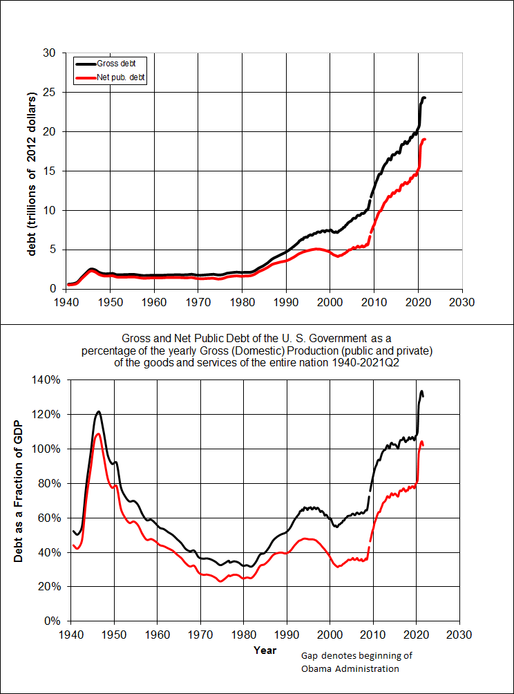
A few thoughts and observations on two charts on debt and deficits since the mid forties to the present.

Follow mainly the red line, which is public debt. Media pundits often comment on the entire debt (the black line) which is not relevant because it is out of government policy control. Fa more important is the record of fiscal responsibility of the Federal Government.

Notice first that our national indebtedness was casually declining for decades after the stimulus spending of WWII, but rose dramatically during the glory years of "reigning in spending" with Reagan and Bush I. It tapers off and eventually declines during the evil, radical, socialist, big spending, big taxing years of Bill Clinton, but then it goes up and up and off the charts during the fiscally responsible, spending cutting, tax-freedom-loving years of Bush II. Finally, with a combination of the loss of tax revenue from joblessness and increases in stimulus spending that began in the last months of the Bush administration, it continued to rise through the horrible, evil, socialist, tax-loving years of the Obama Administraton.

My characterizations were humorous to make a point. The Tea Partiers and their Fox/Talkshow/Republican allies seem to be blaming the Democrats for our debt and in reality it has generally gone down with Democrats and up with Republicans. It went up most during the Bush administration with the income losses of three tax cuts, two wars, a drug treatment program, a huge expansion of government, and the Wall Street Bailout, with no countering plans for paying anything back.

To be fair to Mr. Bush, his debt began during the 2001 recession when people lost their jobs and their ability to pay taxes. That recession was caused by a tech bubble explosion and not government action (though he was known to blame it on Bill Clinton's policies). But all of the rest of the trillions in debt that we acquired during his time in office should be laid at his doorstep.

The Clinton Administration handled the debt with a combination of tax increases and budget cuts. Both were painful, but both were responsible and ultimately (though I did not agree with all of the cuts at the time) they brought us closer to a balanced budget and gave the Bush/Cheney administration the healthiest balance sheet we'd seen in years. 

With some qualifications, I would support the same right now, except that I would argue for postponing the spending cuts until the economy is more stable. Right now large budget cuts of the kind that Obama is proposing and even larger that the irresponsible Republicans are proposing, would damage the recovery and keep us deep in pain until the next election (hmmm, which may well be the Republican plan).

Budget baloney: Social Security isn't to blame for deficit


Social Security won't be a problem for another 26 years, and even then, the problem can be solved.

By Robert Reich, Guest blogger / February 18, 2011

New Jersey Governor Chris Christie, a Republican presidential hopeful, says in order to “save” Social Security the retirement age should be raised. The media are congratulating him for his putative “courage.” Deficit hawks are proclaiming Social Security one of the big entitlements that has to be cut in order to reduce the budget deficit.

This is all baloney.

In a former life I was a trustee of the Social Security trust fund. So let me set the record straight.

Social Security isn’t responsible for the federal deficit. Just the opposite. Until last year Social Security took in more payroll taxes than it paid out in benefits. It lent the surpluses to the rest of the government.

Now that Social Security has started to pay out more than it takes in, Social Security can simply collect what the rest of the government owes it. This will keep it fully solvent for the next 26 years.

But why should there even be a problem 26 years from now? Back in 1983, Alan Greenspan’s Social Security commission was supposed to have fixed the system for good – by gradually increasing payroll taxes and raising the retirement age. (Early boomers like me can start collecting full benefits at age 66; late boomers born after 1960 will have to wait until they’re 67.)

Greenspan’s commission must have failed to predict something. But what? It fairly accurately predicted how quickly the boomers would age. It had a pretty good idea of how fast the US economy would grow. While it underestimated how many immigrants would be coming into the United States, that’s no problem. To the contrary, most new immigrants are young and their payroll-tax contributions will far exceed what they draw from Social Security for decades.

So what did Greenspan’s commission fail to see coming?

Inequality.

Remember, the Social Security payroll tax applies only to earnings up to a certain ceiling. (That ceiling is now $106,800.) The ceiling rises every year according to a formula roughly matching inflation.

Back in 1983, the ceiling was set so the Social Security payroll tax would hit 90 percent of all wages covered by Social Security. That 90 percent figure was built into the Greenspan Commission’s fixes. The Commission assumed that, as the ceiling rose with inflation, the Social Security payroll tax would continue to hit 90 percent of total income.

Today, though, the Social Security payroll tax hits only about 84 percent of total income.

It went from 90 percent to 84 percent because a larger and larger portion of total income has gone to the top. In 1983, the richest 1 percent of Americans got 11.6 percent of total income. Today the top 1 percent takes in more than 20 percent.

If we want to go back to 90 percent, the ceiling on income subject to the Social Security tax would need to be raised to $180,000.

Presto. Social Security’s long-term (beyond 26 years from now) problem would be solved.

So there’s no reason even to consider reducing Social Security benefits or raising the age of eligibility. The logical response to the increasing concentration of income at the top is simply to raise the ceiling.

Not incidentally, several months ago the White House considered proposing that the ceiling be lifted to $180,000. Somehow, though, that proposal didn’t make it into the President’s budget.

Robert is chancellor's professor of public policy at the University of California at Berkeley. He has served in three national administrations, most recently as secretary of labor under President Clinton. He has written 13 books, including 'The Work of Nations,' 'Locked in the Cabinet,' and his most recent book, 'Aftershock: The Next Economy and America's Future.' The original of this post can be found at
 http://www.csmonitor.com/Business/Robert-Reich-s-Blog/2011/0218/Budget-baloney-Social-Security-isn-t-to-blame-for-deficit

The Stimulus and Poverty --Two articles


Stimulus kept millions out of poverty, liberal group’s study says

By Zachary Roth
Yahoo News
http://news.yahoo.com/s/yblog_thelookout/20110120/ts_yblog_thelookout/stimulus-kept-millions-out-of-poverty-study

The stimulus bill of 2009 was intended primarily to get the economy going again. But according to a recent study by the progressive Center on Budget and Policy Priorities, it had another major benefit: keeping millions of Americans out of poverty. That finding comes just as Congress considers cutting many of the spending programs at issue.

Consider this: In 2008, the number of Americans living in poverty rose by 1.7 million, to nearly 47.5 million, according to census data. You'd have expected that number to keep rising in 2009, as unemployment kept going up, and many Americans lost their homes to foreclosure. But in fact, it held steady.

Why? According to the study released this month, it was thanks to the American Recovery and Reinvestment Act, better known as the stimulus bill. The center found that the bill kept more than 4.5 million people out of poverty in 2009.

How? In addition to funding infrastructure projects, the stimulus bill also bolstered existing government programs that support struggling Americans, and created new ones. It did so because, as we've written, putting more money in the hands of poor people has a greater stimulative effect on the economy, since they have little choice but to spend the money quickly, rather than save it.

Here's how the study breaks down those programs and their effect on poverty:
• Extensions and expansions of unemployment benefits kept 1.3 million people out poverty.
• Improvements in the Child Tax Credit and Earned Income Tax Credit kept 1.5 million out of poverty.
• The Making Work Pay tax credit kept nearly 1 million people out of poverty.
• Increases to the SNAP program (formerly known as food stamps) kept 700,000 people out of poverty.

"These findings indicate that the Recovery Act is one of the single most effective pieces of legislation at preventing poverty to be enacted in decades," the report's author says.
The author continues: "It is difficult to think of a single piece of legislation since the Social Security Act of 1935 that kept more people above the poverty line in 2009 through direct assistance to households than the Recovery Act."

The study comes at a key moment. Already, some portions of the stimulus bill have been reduced. The tax cut deal made last month between President Obama and House Republicans will mean jobless benefits are worth $25 a week less than under the stimulus, according to a New York Times editorial. That doesn't sound like much, but it could push an estimated 175,000 people a week into poverty, the editorial says.

And that may be just the start.  GOP leaders have said they plan additional deep cuts to government spending next month. (They originally pledged to trim a whopping $100 billion but have since backed off that figure.) They've offered few specifics on where the cuts will come from -- but it's all but certain that they'll be targeting other social programs created or bolstered in the stimulus bill for cuts.

Such moves could stunt the still-weak recovery, as many observers have pointed out. But it looks like steeper spending cuts also could drive millions more Americans into poverty, too.


The Stimulus Reduced Poverty
—Rick Cohen
 The Non-Profit Quarterly
http://www.nonprofitquarterly.org/index.php?option=com_content&view=article&id=8976:stimulus-staves-poverty-says-cbpp&catid=155:nonprofit-newswire&Itemid=986

The jury may still be out on the impact of the American Recovery and Reinvestment Act on creating jobs and reviving the economy, but a new study by the Center for Budget and Policy Priorities makes a different point about the value of the federal stimulus program. ARRA kept "millions of Americans out of poverty," according to CBPP.

CBPP says that the stimulus prevent 4.5 million people from joining the ranks of the poor by putting resources into existing government programs and by capitalizing new ones to help poor people in the midst of a ghastly recession. Through programs such as the extension of unemployment benefits, improvements in the child tax credit and the Earned Income Tax Credit, increases in food stamps, and the creation of the Making Work Pay tax credit, the stimulus put money directly into the hands or pocketbooks of Americans facing economic challenges.

According to the CBPP, the funds from these programs were spent quickly because poor people had "little choice but to spend the money quickly," and therefore had a greater stimulative effect on the economy than other mechanisms such as slow-spending infrastructure investments or tax incentives for corporations. CBPP's powerful conclusion was, "The Recovery Act is one of the single most effective pieces of legislation at preventing poverty to be enacted in decades . . . It is difficult to think of a single piece of legislation since the Social Security Act of 1935 that kept more people above the poverty line in 2009 through direct assistance to households."

CBPP might have further added the various housing, weatherization, employment, and health programs that the stimulus program funded – delivered largely by nonprofits –that provided crucial safety net program supports that supplemented and bolstered the income transfers lauded in the CBPP study.

With the 112th Congress, there are a number of new legislators committed to broad and deep cutbacks in social safety net spending, ostensibly to staunch the growth of a burgeoning federal budget deficit, in some cases motivated more by animus against programs that they see as undermining individual responsibility. Whatever the impetus, the result of such cuts could be a reversal of the CBPP findings, driving families into the poverty conditions that the Recovery Act had helped them avoid.

Americans and Health Care

Here's an interesting tid bit from today's news. In this poll, released Friday, January 21, 2011, it was found that the majority of Americans did NOT want Congress to put Health Care at the top of their agenda, and only 40 percent of them wanted to see it repealed. The majority does NOT want to repeal the health care act of 2010. It turns out that the numbers for repealing the act have never been high, and they have been going down steadily.

It's helpful to point that out because it is not something one would surmise from hearing the heated debate about this in Congress or even the reports on it in the media. This is similar to this CBS poll that came out in September, and this one that came out in December, the week before the vote in Congress to extend the Bush-era tax cuts for the very wealthy. In both instances, people did NOT want an extension of the tax cuts. For all of the heated rhetoric about how the "American people" want this because they don't want taxes for anyone to go up, the surprising fact was that people said just the opposite. The"American people" did NOT want the tax cuts extended to the wealthy and they were even pretty lukewarm about whether their own cuts should be extended.

But, in both cases, members of Congress (frankly, I mean just Republicans, but I'm trying to be fair) still voted against the will of the people, claiming to be voting for what the "American people" wanted. And there are other examples. People want one thing and Congress votes for the opposite claiming a mandate from the people. It is not uncommon.

But how does that happen? How can Congress ignore public opinion and continue to get away with it?

Well, though it has probably happened to some extent since the ancients first began tinkering with voting for their representatives. But it is considerably easier today, for two reasons.

First, the districts for Congressional representatives have been drawn in such a way that the vast majority of the people in their districts are of only one party. So, a Republican, let's say, can know that for the time being in the conceivable future, a will ALWAYS be elected in District "X." Second, the reality of politics today are that in each of the primaries (which have become the only places were meaningful elections are taking place), the largest majority of voters are the true believers, the activists. And for the Republicans, that means a very large number from the radical right wing fringes, the Tea Party, the gun lobby, the religious conservatives, etc. So, when a Republican is running for office, he or she does not need to be concerned about the general national opinions of "Americans." Or even of the more moderate opinions of general Republicans. All he or she needs to appeal to are the far right voters who are going to show up in the primaries. In fact, in Today's climate if a Representative decides to vote too often with the opinions of the vast middle of America, he or she would probably lose out in the next primary because the middle does not represent the voting block that shows up to vote.

Doesn't bode well for Democracy, but then, what else is new?

Stay warm and safe. It's getting cold out there. 


The "Job-Killing" Health Care Bill


January 17, 2011
Stan Duncan

I think (or at least I pray) that by now everyone knows that the respected, centrist, non-partisan (that means middle of the road, solid, not Democrat or Republican) Congressional Budget Office has scored the Health Care bill of last year and in a preliminary report, it says the bill will create jobs and decrease the budget.

And everyone knows that John Boehner, incoming Speaker of the House, has said the numbers from the centrist, non-partisan, professional budget analysts are just “their opinion” (the kind of language one uses when talking about differences of opinion on, say, why the Patriots lost to the Jets, not conclusions from professional budget analysts).

And that he and several other Representatives on January 6 (Epiphany), have released their own unbiased, objective, analysis that they call the “Budget-Busting, Job-Killing Health Care Law” (to see it, click here) which contradicts the centrist, respected, non-partisan CBO.   

Click here to see the CBO’s January 17, 2011 letter to Mr. Boehner, saying that repealing the health care bill would actually increase the budget deficit, not decrease it as he and other Republicans frequently claim.

And finally, as you probably also know, the Republicans in Congress continue to refer to it as “Job Killing Obama Care,” and have voted to repeal it in the name of saving the jobs the CBO says will not be lost by it. In fact the resolution in the House to repeal the bill was called the “Repealing the Job-Killing Health Care Law Act.” That’s not a joke. That’s the real name of a piece of legislation passed by the House of Representatives in the world’s most respected Democracy.

For what it’s worth, click here to go to the equally non-partisan “FactCheck.org,” and see their analysis of the health care bill, and their findings that, in spite of the many claims by Republicans, the new bill will have little or no effect on jobs. They conclude that while the new law will likely lead to somewhat fewer low-wage jobs (because of the law’s requirement that firms with more than 50 workers pay a penalty if they fail to provide health coverage for their workers) on the other hand, the relatively small losses would be partly offset by gains in the health care industry.

So, how were the Republican staff people able to look at the bill and continue their claims that it will kill jobs and increase the deficit?

First was the inclusion of the so-called “Doc Fix.” That’s an issue that arose in 1999, when the formula for reimbursement of Medicare patients was changed and doctors and hospitals began to be paid so little that some of them refused to take Medicare patients. Congress has never refigured the formula, but has made a temporary “Doc Fix” every year to increase compensation. The new health care law makes the “fix” permanent. It regularizes an increase in Medicare payments at the yearly fixed level to keep from having to go back each year and pass the same measure.

According to the Boehner staff people, this fix--that simply budgets for doing what we have been doing for 11 years--is actually an increase in spending. I don’t want to sound unfriendly about this, but that is a little bit like saying that I’ve been spending about $700 for gas every year, so next year I’ll put that amount in my family budget. Then someone else accusing me of increasing my annual spending because I’ve decided to put what I am already doing in the ledger where I can monitor it.  

Second is the number of jobs that the Boehner report says will be lost is based on a bill that did not become law. They believe that the bill will result in the loss of 1.6 million jobs and they support that by citing an early analysis by the National Federation of Independent Business.[1] However, the NFIB study was written in January, 2009, and not based on the final health care bill. It looked at early versions that contained an expensive and hypothetical employer mandate that did not make it into the final law. For good or ill, the final version is not as forceful and makes allowances for companies with under fifty employees. Mr. Boehner’s report never tells us that and includes the costs of the early version of the mandate as though it had become law. It didn’t.

And, incidentally, the NFIB study also notes that even had the larger mandate become law, there would still have been an  increase in jobs from the health care bill, because of increased labor demands in the health care industry.[2] The Republican report, while citing potential job losses in the NFIB study, does not mention its discussion of increases.

Third, it cites an April, 2010, CBO study that said that start-up costs of the bill might be as high as $115 billion. They are correct. However, the new CBO study attempts to allow for that by scoring the costs and benefits over ten years, which are past the start-up costs and which brings it to the conclusion that on balance the bill will actually cut costs, not increase them. The Republican report does not acknowledge that.

Fourth, it misrepresented the CBO study's finding that the bill would reduce the number of employed. 
What the report exactly said was that, "The legislation, on net, will reduce the amount of labor used in the economy by a small amount _roughly half a percent_ primarily by reducing the amount of labor that workers choose to supply."[3a] Their point was that because of better benefits, and better health care, there could be a slight uptick of people who have been hanging onto jobs, who could now decide to retire and leave the work force. The Republicans did the math on that one half of one percent and came up with the claim that the bill would kill 650,000 jobs. No it won't. And they supported that claim by saying that they got it from the CBO report. No they didn't. A voluntary reduction in workers because they no longer have to work to keep their health care, is not the same as "killing jobs."

My suggestion is that even if you don't like the health care bill, you shouldn't lie about why.

Finally there are a couple of smaller things that are interesting. This is complicated, but the CBO accounted for the fact that if because of the bill jobs go up and income goes up (something they say will happen) then income will go up (if only slightly), and that will cause revenue to Social Security to go up. Also, if more people have health care, then eventually charges to Medicare will go down because we will have a slightly healthier society. These factors are not huge, but should be factored into the totals.

The Republican report discounted this for two reasons. First, they say that since Social Security and Medicare have already budgeted for those people, allowing for savings from not treating them would be “double-counting.”[3] If I understand that argument (and their report noted it three times) they are saying that if you budget for a certain amount, yet don’t spend the whole of that amount, it shouldn’t be counted as savings because you budgeted for it. You claimed you were going to spend it, so you can’t say it was savings when you didn’t spend it. That sounds odd, but it does seem to be what they are saying. For what it’s worth, in my defense, Paul Krugman also wrote on this, and he doesn’t understand it either.[4]   

Second, they say that if both of these things are true--that people will live longer and dip into Social Security and Medicare longer--it will therefore be an ultimate financial drag on those two programs, and that is a bad thing. We will ultimately have an older, healthier nation, but we’ll have to pay for it.

That may be true, but as a kind of soft-hearted religious liberal, I’m unsure of the point. Should we therefore not do things that will make people live longer? Being healthy in old age is a bad thing? I don’t want to evoke Jesus into a conversation with Christian Republicans, but I’m not clear on why helping people grow old healthy is wrong. Is that really a reason to repeal the health care law?

My bottom line on this topic, as it is for so many similar topics, is that we as a nation need to have a clear-eyed adult conversation about what we can do about the health care crisis that has been slowly strangling people in this nation for decades. Every year more and more people are unable to afford health care and the tab is picked up by you and me when they fall into Medicaid or emergency rooms in hospitals. But we’re not. The kind of smoke and mirrors that is being produced in the debate is insulting and demeaning and it does not represent the voice of a healthy democracy or our better angels.   

[1] Obamacare: A Budget-Busting, Job-Killing Health Care Law, January 6, 2011, p. 5.  
[2] “Small Business Effects of a National Employer Healthcare Mandate,” Michael J. Chow and Bruce D. Phillips NFIB Research Foundation, Washington, D.C. January 26, 2009, p. 20, cited at  http://factcheck.org/2011/01/a-job-killing-law.
[3] Obamacare: A Budget-Busting, Job-Killing Health Care Law, January 6, 2011, p. 13.
[3a] Ricardo Alonso-Zaldivar, "FACT CHECK: Shaky health care job loss estimate," Associated Press, Jan 18, 2011, http://news.yahoo.com/s/ap/20110118/ap_on_bi_ge/us_health_care_repeal_fact_check.
[4] Krugman, “The War on Logic,” New York Times (January 16, 2011),   www.nytimes.com/2011/01/17/opinion/17krugman.html?src=ISMR_AP_LO_MST_FB.