Sermon Notes

John 6:1-21
Fourth Sunday in Lent, Year B
Proper 12/ Ordinary time 17, Year B


As some of you know, I’m putting together a book of sermon notes that highlight economic justice themes in biblical texts.I just finished this draft of the chapter about the feeding story in John and I’d be interested in your comments.
Blessings, 
Stan


_____________________________________________________


It is often overlooked that the three most important interests in Jesus’ ministry were education, health care and food security.[1] The last of these three is never seen more clearly than in the feeding stories of the Gospels.

The first thing that is important to know about the feeding stories is that they are among the most significant in the gospels. Feeding is the only miracle that is shared in all four gospels, and two of them may have told it twice. Both John and Mark have two feeding stories each. So, either (a) both of them thought the story was so important that they wanted to share it twice (which would attest to its significance to the early church) or (b) Jesus did more feeding than most of us had assumed (which would attest to its significance in the ministry of Jesus).

The story is laden with symbolism, some of which is apparent to “normal” readers (whatever that means), and some are not. I’ll point out a few of the most important, but John starts right at the very beginning adding little interesting messages.

Notice, for example, that it begins with Jesus getting off of a boat at the Sea of Galilee. All of the four gospels agree on this. But John adds that it was also known as the Sea of Tiberias. Why did he do that? Probably because Tiberias was one of the most hated and politically volatile cities in Palestine, and he wants the reader to take note of that. It had been in existence for only a few short years, built by Herod Antipas in 20 c.e. at the edge of the Sea of Galilee (and Jesus’ ministry was probably somewhere around 30 c.e.). What made it a hated name and avoided by many locals was that it was built upon a local Jewish graveyard and was therefore considered unclean to observant Jews. Only people from outside of Israel (and sellouts within Israel) would ever dare living there.

Additionally, between the time of its founding and the time of Jesus, it grew rapidly to become the largest city in Israel, surpassing even Sephorrus, which had itself only been built a few decades earlier. This meant that in less than a hundred years Israel had three major cities, all demanding resources from the surrounding farms and villages. Among other things, this put increasing demands on the food supply of the region and contributed to an upswing in hunger throughout Israel. It was in turn exacerbated by the pro-city economic policies of Antipas, which forced rural farmers to either give up some of their produce to feed the cities or pay a tribute on what they did not give. So, the more they grew the more they had to pay in tribute to the powerful urban centers. Farmers could lower the amount of tax they paid by not growing as many crops, but that would also lower the amount of food they had for their own personal consumption. They lost either way. Bible scholar Obery Hendricks, describes the economic life of first century farmer this way:

Most peasant farmers had land holdings of less than six acres, of which on average only 1.5 acres was available for cultivation, hardly enough to support a family. That is, if they were fortunate enough to have saved their farms from outright seizure by the Romans, or from dispossession for tax default, or from the machinations of the Herodians and their cronies who, it is estimated, owned one-half to two-thirds of the land in Galilee. To make ends meet, most farmers either had to hire themselves out for wages to supplement their meager crops, or go into debt, which was usually a worse alternative. Tenant farmers and share-croppers often fared even worse, ending up in prison or enslaved by their creditors. [2]

When food production went down, it did two things. First it simply lowered the amount of fruits, vegetables, and grains that could be consumed and made the region grow incrementally more hungry. Second, and more interestingly, when huge percentages of the grains were taken out of system, it made the prices of the remaining grains go up. It’s simple Econ 101: when there is more of something the price goes down and when there is less of something it goes up. So, there was less food to go around and the food that was grown cost more to purchase for the families who didn’t have direct access to it themselves.

In many ways this is a story that could be told of many in the world today. Following the global economic “reforms” of the 1970s and ‘80s, much of the farming in poor and developing countries of the global south was reoriented from production for local consumption to production for exports. In some instances they were pushed to sell larger and larger portions of their wheat or other grains to the government or middle people which would then export it to the wealthy, usually northern, countries. In some instances they would cease food production altogether and grow instead something like hemp or coffee. In this activity, a great many people made--and still do make--a lot of money, but it should be noted that the same two principles that exacerbated hunger in ancient Israel still held: taking food off of the market meant that there was less of it, and what remained went up in price. So, over all, while many people benefitted from globalization and the rise of the global “free” market, by and large the poor farmers of the world became more poor.

When the ancient farmers of Israel were unable to pay the tax, they did have access to a convenient loan program from the large wealthy land owners to the small poor ones, to tide them over—but it was often as high as fifty to sixty percent interest! With this vicious combination of taxes and loans, whenever there was a bad harvest either from drought or unseasonable rains, many farmers would simply lose everything and have to sell themselves as slaves to their creditors. High rates of interest were one of the key tools used for creating poverty and debt slavery in the ancient world. This too has a contemporary parallel. Leaders of third world countries in the global south took out huge loans in the 1970s, under the belief that they could export enough to the north to pay them back. In the eighties, two things happened at once to destroy that dream. First, the wealthy countries of the global north went into a recession and cut back on purchases of the products that the poor countries were trying to sell, driving prices downward. Second, partly because of the recession and partly because of the US Federal Reserve tightening credit, the interest on the loans went up. So, the costs for their loans went up and their income to pay on them went down. Poor countries fell into an economic black hole from which they have still not quite recovered. To keep them paying on their loans, the wealthy and powerful countries, and the multi-lateral banks that they control (like the World Bank and the IMF), made stringent, draconian demands on the poor countries that many people of faith and conscience today believe to be a modern version of slavery. Different, but in many ways similar to the demands imposed on small farmers in ancient Israel by Antipas and large land owners.

All of this background is tied closely to the feeding story and is related to why John wanted you to know that this took place close to the hated city of Tiberias. Have you ever wondered why it was that everywhere that Jesus went he was swarmed by great crowds of people? Where did they come from? When he is in the towns, you may not see the thousands, but there are still hoards of people flocking after him. Even allowing for some exaggeration from the Gospel writers, it still is an interesting phenomenon. Where did they come from? These stories were for the most part in the middle of the day. Don’t they have jobs?

The answer is “no.” These were people who were driven off of their land by poverty and hunger and oppression by their rulers. They often were not able to pay the demanded tribute and feed themselves at the same time and got desperately into debt and finally lost their farms.[3] Some in fact moved back onto their own farms as indebted workers, but many just became homeless, beggars, prostitutes, thieves, and day laborers. When they heard of Jesus, teaching, healing and feeding in the region or neighborhood they flocked to see him. So, when he got out of the boat at the beginning of our story, and the crowds saw him, they clamored for him, wanting to see or experience some of the healing signs that they had heard had taken place through him.

Notice that out of the blue, John mentions in passing that this took place near the Passover. Why did he think that was important to mention here? Of course part of it was probably because he wants the reader to think of Jesus as the new Moses, who also delivered bread (manna) from a mountain (Exod. 16:4, cf. John 6:31-33). But it is also likely that once again John wants us to feel the politically charged atmosphere surrounding this event. In a fairly consistent way, whenever John makes note of an event being close to a Jewish festival, he has Jesus present some kind of controversial teaching that subverts and undermines a traditional teaching that is held by the religious authorities, and the result is often a confrontation with those authorities (cf. 1:13ff; 7:2ff; 10:22ff; 12:1ff)”[4] While in this instance the religious authorities do not show up until after the feeding story, the provocative, confrontational nature of the feeding is nonetheless clear here as well.

Here is where the story gets very interesting (I bet you thought it was interesting already). When the crowd comes up the hill toward Jesus and his disciples, he leans over to Philip and asks, “Where can we go to buy enough bread to feed these people?” He already knew the answer to that question when he asked it, but he did it anyway to see what Philip would say. And Philip comes up with the straightforward economic reality: No place. Nowhere. It’s impossible. He says that to feed these people would take six months of wages, and nobody--certainly not the rag tag crowd that followed Jesus--had that kind of money. Even if Judas had not been skimming donations from the till, they still couldn’t do it. Six months wages (or eight or ten, depending on the various translations) are guesses. In the Greek it says two hundred denarii. A Denarias was about one day’s wage for a common laborer, so Philip is saying it would take two hundred days worth of work to feed these people. That’s a pretty precise statement. Why not be more general as numbers often are in the Bible? Philip’s precision is interesting. I think that in addition to just simply saying that this is a chunk of change, it is likely that Philip is also making an exasperated statement about the outrageousness of the escalating prices in his day. He’s making a statement about the impossibility of buying food to live on in an age of stagnating wages and inflationary prices. And if so, he is certainly correct.

As an aside, I also find it interesting that Jesus asked the “where” question, “Where are we to buy bread for these people to eat?” But Philip answers a different question, “How much will it cost to buy bread for these people to eat?” Jesus question assumes that they will buy bread and can buy bread. Philip’s answer makes it clear that he doesn’t think they can buy that much bread, no matter where the bakery is.

Before Jesus could say anything, Andrew, Peter’s brother says—also sounding exasperated and futile—”Well, we have a boy here who has some fish and bread.” It’s not altogether clear in English, but his choice of words indicates that he also thinks this is a lost cause. The words “boy” and “fish” are diminutive, that is, a “small boy” and a “small amount of fish.” Also, the use of the term “barley” loaves has a negative connotation because only the very poor and the very desperate would lower themselves to eating this tasteless bread. Translated into more clear English, he’s saying “We’ve got bubkes here, zilch. Our resources are tiny. The market’s gone to Hades and just to illustrate that for you, look at what we got: a little kid with a couple of fish and some really smelly barley, which taste awful and I’m not going there.”

Then Jesus does an odd thing. But before we get to it, let me say what Jesus did not do. He did not offer communion. That is, when he took the loaves, broke them, gave thanks, and gave them…, he was not imitating some form of pre-communion, even though the Gospel writers, writing many years later, certainly had it in mind, and even though approximately 487 gazillion preachers have said he did. Whatever else he was thinking of up there on the mountain, it is all but one hundred percent certain that Jesus did not have the Celebration of Holy Eucharist on his mind while he was breaking bread and handing it out. If he did, what would be the point? The crowd that gathered there that day would have no idea what he was talking about. Almost every Bible scholar on the planet (with the possible exception of my cat, but that may just be her) believes that the Gospel writers retrofitted that theology back into the actions of Jesus because that was what they were thinking of, not Jesus.

Now what was Jesus thinking of? If the accounts can be accepted, he was looking out onto a sea of faces, all poor and almost all hungry. They represented the wide swath of the bottom of Israelite society of the day. They were probably far more than 5,000 people, because in those days they only counted men, not women and not children. So a good guess would be at least ten thousand, perhaps as many as twenty. Again, if the crowd estimates can be accepted, by any accounting that would be an incredible amount of people.

Look again at the four acts described before the actual feeding itself: he “took,” “gave thanks,”[5] “broke,” and “gave.” While these probably are not images that prophesy upcoming Holy Communion, they probably are images that hearken back to traditional Hebrew gestures of a gracious host welcoming guests to his banquet table (except that Jesus’ guest list was a bit larger than most).

Think about the first two words, “took” and “blessed.” These are welcoming acts, and in a typical first century Jewish family, these are the acts of hosting. The last two, “broke” and “gave” are acts of serving and they are acts done by a slave (or worse, a wife). Notice that before Jesus either welcomes or serves, he has everyone in the crowd “recline” (anepeson [anapípto]), which is the posture one takes in a banquet, not an ordinary meal. To recline means that the host has to lean down to serve you. It is also the posture that Jesus takes later in the last supper, when he also serves. In doing this, Jesus in a subtle, almost radical way, has symbolically taken on the role of both master and slave, husband and wife, and welcomes everyone to the table.[6] When he does that, the participants almost certainly realized that something very special was about to happen.

So far, he is doing two things. First he is embodying the majestic vision of the “messianic banquet” of the Hebrew prophets, who were in turn envisioning the Jubilee, when all of God’s creation that has been broken and disfigured by human corruption and greed, will be returned back to the order of harmony and justice that God had originally intended. In the days of God’s final dispensation, a celebration of justice and equality will break out all over the land, and it will be symbolized by the one thing that most common people lack: food. There will be a great and glorious banquet on the mountain tops, which will be attended by all who can walk or crawl (and some who can do neither).

On this mountain the Lord of hosts will make for all peoples
   a feast of rich food, a feast of well-aged wines,
       of rich food filled with marrow, of well-aged wines strained clear.
                                                                            — Isaiah 25:6

Most significant for a Christian interpretation of this act is that throughout his ministry, Jesus many times—here included—became the vision of the banquet. He acted it out in his behaviors with others and embodied its salvific meaning. He had, in fact, a reputation as a “glutton and a drunkard, a friend of tax collectors and sinners” (Mt 11:19). It was considered a criticism by his enemies, but a beacon of what God intended for the earth to his supporters. He “welcomes sinners and eats with them” (Luke 15:1–2) and in so doing he becomes God’s magisterial welcome mat to sinners (which we should remember, included people who were sick, contagious, old, non-Jews, immigrants, criminals, and women) to enter in and become a part of the true end for humanity, the “kingdom” of God. The Last Supper, instead of pointing backward to this feeding story, was actually pointing forward to the coming eschatological banquet when he says, “I will never again drink of this fruit of the vine until that day when I drink it new with you in my Father’s kingdom” (Matt. 26:29; Mark 14:25; Luke 22:18; cf. Luke 22:28–30).

Second, Jesus is also not just symbolically being the new realm of God embodied on earth, he is modeling a way to create it. “The Kingdom of God is within you,” he once told them, and here is what it looks like. Notice how he does that. He holds up the little boy and distributes his paltry offering in front of everyone, and suddenly there is an abundance of food. There are a number of scholars today who believe that what happened in the various feeding stories was much less magical than they sound in the preaching of most sermons, but far more miraculous.

It’s very likely that what happened was something like this: Jesus took the little boy and he set him in front of the crowd and said, “Hey, hey, all of you. Listen up. Look up here, focus. Okay. Now I know that all of you are very poor. All of you have felt like you have been caught up in the economic crash that drove up the prices of food and drove down your income. We all know that. And all of you are afraid that you don’t have enough even to survive on your own and you’re afraid to spend anything. Now, I’m not going to give you a long lecture about Keynesian economics and how major economic actors need to step in and invest and spend and loan until the smaller actors can get their faith and trust and security back. Rome may get around to something like that one of these days, but until then, I’m going to try something else. Something that might work in the long haul. Something that might bring in the Kingdom you’ve all heard so much about. I’m going to put this kid out here--with his frankly dismal offering--for all of you to look at. He’s offering to give us everything he’s got and I want you to see that. And then I’m going to break up his bread and give thanks to God for it and start distributing it to all of you, and…well, let’s see what happens. Alright? So bow your heads I’m going to pray” and he starts praying.

And then, I think, as the bits and pieces of food are handed down the aisle, one person starts to think to himself, “Y’ know, the wife did make me this sandwich and packed me this thermos of coffee, and I probably don’t need all of it, so I’ll break it in half and pass it down with the barley.” And then the next guy says, “Well, I do have this banana that I forgot to check at the gate when I came in, and I don’t need all of it,” so he breaks it in half and passes it down. And then there’s the guy who picked up the box of Oreos at the Seven Eleven that morning on the way out of town to the rally. And the one who won the turkey at the meat raffle at the Grange meeting last night. And the one who remembers he still has a piece of that fruit cake left over from a party last year that never went bad. And so on, all down the line, until all the loaves and fishes had been passed around and the disciples gathered up twelve baskets full of leftovers and party favors.

Goodness. Now that would be a miracle!


[1] The list is probably slightly exaggerated, but close enough to make the point.
[2] Obery M. Hendricks, Jr., The Politics of Jesus: Rediscovering the True Revolutionary Nature of Jesus’ Teachings and How They Have Been Corrupted (Doubleday, 2006) p.
[3] See Amy Jill-Levine, “Visions of Kingdoms” the Oxford History of the Biblical World, Ed. Michael D. Coogan (Oxford University Press: 1998), p. 364.
[4] Homiletics, “Jesus Doesn’t Use IVR!” July 30, 2006.
[5] Actually the synoptics say “blessed” (eulogēsen); John’s Gospel says “gave thanks” (eucharistēsas), but the difference is not great enough here to quibble.
[6] In the words of John Dominic Crossan, “Long before he was the ‘host,’ he was the hostess.” The Historical Jesus: The Life of a Mediterranean Jewish Peasant (HarperSanFrancisco, 1991), p. 404.

When Hitler Learned that Brown Won the Election


I can't tell whether the originators of this video supported Scott Brown or Martha Coakley, but the video is funny either way. The democrats in Massachusetts (and in Washington, for that matter) deserve all of the vilification that they have been receiving recently.

Now that they have allowed the Republicans to redefine "majority" up from 51 percent (as it was under George Bush) to 60 percent, the suicidal election in Massachusetts may mean that democracy as we know it will cease to function in the U.S. for anytime in the foreseeable future.

Ford Motors and Democracy in America

Here’s an interesting story that has to do with power, influence, “Free” Trade, and democracy, in case you missed it. At the bottom, check out three repeat announcements plus a new ad for a great magazine.

Back in the sixties, Volkswagen was making killing in the American market selling its mini-utility-vans. Some of you (of a certain age) probably owned one back then with a sun burst on one side and a peace symbol on the other. The popularity of the vans cut into sales of the big three U.S. auto makers, so the companies went to their friends in Congress, whose re-election campaigns they paid for, and got them to write an anti-competitive, anti-free market law that put a whopping 25% tariff on foreign manufactured utility vans imported into this country. That slowed down considerably the imports of those mini-vans. (I’ll bet you thought they tapered off just because you got married and your spouse thought they were tacky.)
Pic of minivan That plan worked fine for a while, but years later, Ford began sending its truck-building jobs overseas to plants in countries with cheap wages and no unions and then shipped the trucks back here to be sold. One in particular was a light-weight commercial van called the “Transit Connect,” which they manufactured in Kocaeli, Turkey. The trouble was that when they tried to import it back to the U.S. they were slapped with the same high tariffs on utility vans that they had once told Congress to write for them to keep out Volkswagon mini vans. Chalk that up to the law of untended consequences.
Not one to let the law get in the way of profits, Ford started marketing their new vans as “family vans” instead of “utility vans.” The reason was that the tariffs on “utility vans,” you remember, was 25%, but “family vans” were 2.5%. A big difference. But the two vans weren't really very similar, so to make the scam work, Ford had their plant in Turkey outfit the utility vans with family-van-style seats and windows and then export them to the U.S. as “family vans” instead of “utility vans.” Then, when they arrived and snuck past customs disguised as “family vans,” they were taken to a “Vehicle Modification Service” in Baltimore, where the seats and windows were taken out and replaced with panels and new floors and the vans were sent to dealers to be sold as utility vehicles. What a deal.

But then they had another problem. What to do with the windows and seats that were put in (and then taken out) to make them pass for family vans? Originally they planned to send them back to Turkey, where they would put the seats and windows into new vans and then send them back here again. But the transportation costs were too high for that, so instead they decided to send them to someone up in Ohio, who breaks out the glass and rips out the cloth from the seats and sells all of the pieces for scrap. That allows Ford to advertise all of this ripping out and selling of brand new seats and windows as a part of its exciting new “recycling” program. They actually list the whole program in their Annual Report as an example of how they have become a “green” company.

I’m not making this stuff up.

(Sources: “Sustainable business growth creates lasting value,” Environmental and Social Responsibility Report of Wallenius Wilhelmsen Logistics, 2007, p. 9; The Port of Baltimore, July/August 2009, p. 1b; “Creative Ways Around Import Tax Barriers,” NPR, “Morning Edition,” September 23, 2009; Matthew Dolan, “To Outfox the Chicken Tax, Ford Strips Its Own Vans” Wall Street Journal, September 23, 2009, p. A12).


Announcements and Ads
(Don't quit reading yet, these are good)

Jubilee Action Party: January 10
When: January 10th, 2009 2 pm-4:30 pm
Where: Hope Church, UCC
87 Seaverns Avenue Jamaica Plain
Parking is available, and you can access the meeting from the side entrance to Capen Hall.

Please join us for a Jubilee USA Action Party on Sunday, January 10th! It will be an exciting chance for Jubilee activists from across the state to celebrate our past victories and plan for the February Change Not Chains National Week of Action to pass the Jubilee Act.
The party will be hosted by Jubilee activists, Neeka Stanley and Stan Duncan


Pilgrim Association Mission Fair: February 6
The Missions Committee (of the Pilgrim Association of the Massachusetts Conference of the United Church of Christ) hosts a fair once a year for a broad range of mission and justice organizations. Organizations are invited to come, set up a booth and talk about their work. Typical organizations are Bread for the World, Equal Exchange, Church World Service, Heifer International, Jubilee USA, Habitat, and others.

If you are interested in faith-based mission and justice work, if you have a local project you would like to show off, if you would like to schmooze for a few hours on a Saturday with people who share your values and commitments, sign up and come.

Keynote Speakers: Sr. Linda Bessom, Faith Into Action Together (Coordinator) , Mass. Conference Task Force on Homelessness, Massachusetts Coalition for the Homeless
and Sr. Diane Whitmarsh, intern at Faith Into Action Together

Date: February 6
Registration 9:30
Beginning time: 10:00
Place: First Congregational church, UCC, Hanover, MA (For Directions, Click here)


Ecumenical Advocacy Days: March 19-22
A movement of the ecumenical Christian community, grounded in biblical witness and our shared traditions of justice, peace and the integrity of creation. Our goal is to strengthen our Christian voice and to mobilize for advocacy on U.S. domestic and international policy issues.

This Year's Theme: A Place to Call Home: Immigrants, Refugees, and Displaced Peoples
And Jesus said to him, ‘Foxes have holes, and birds of the air have nests; but the Son of Man has nowhere to lay his head.’ -Luke 9:58

* Dates: March 19 – 22, 2010
* Registration: Click here for a form
* Location: DoubleTree Hotel in Crystal City, Virginia just outside Washington, D.C. Click here for directions and here for reservations at the special conference rate (Make your reservation under the name “Advocacy Days”).
* Warning one workshop in the Global Economic Justice track is being led by Stan Duncan, but don't hold that against them. The rest of the conference will be fine.

For more information about Ecumenical Advocacy Days, please visit www.advocacydays.org on the Web.


Tikkun {tē-kűn} to heal, repair, and transform the world

This is a blatant ad for a magazine that most of you have heard of, but few subscribe to. Tikkun is a wonderful interfaith magazine of religious and political commentary that most everyone reading this newsletter would benefit from subscribing to. It takes on some of the big issues of war, peace, justice and equality from a dedicated and wide range of faiths perspectives.


In this age of major declines in reading and reading print magazines in particular, and especially reading print magazines from a religious perspective, you should subscribe to Tikkun. I have read it and stolen sermon ideas and conversation starters for years.


Below is a selection of some of the articles that appear in the January/February 2010 issue. You can click on them and go to the web page and see the article. They make a few articles from the current issue available to web visitors. Click on the link at the bottom of this note to subscribe. You'll be glad you did.


Click here to check out the full table of contents for the current issue. Click here to check out archives of our past issues.
Click here to subscribe to the magazine.
Important Events Coming up. Mark your calendars

Jubilee Action Party: January 10
Where You Will Celebrate Jubilee Victories and Help Organize an Event for the February Change Not Chains National Week of Action
When: January 10th, 2009 2 pm-4:30 pm
Where: Hope Church, UCC
87 Seaverns Avenue Jamaica Plain
Parking is available, and you can access the meeting from the side entrance to Capen Hall.

Please join us for a Jubilee USA Action Party on Sunday, January 10th! It will be an exciting chance for Jubilee activists from across the state to celebrate our past victories and plan for the February Change Not Chains National Week of Action to pass the Jubilee Act.
The party will be hosted by Jubilee activists, Neeka Stanley and Stan Duncan

Come meet other activists, learn more about Jubilee, and take action! To RSVP click here. Please feel free to invite family and friends for what's sure to be an amazing event!


The Fourth Annual Pilgrim Association Mission Fair: February 6

This is an event which is hosted locally, but has participation from all over. The Missions Committee (of the Pilgrim Association of the Massachusetts Conference of the United Church of Christ) hosts a fair once a year for a broad range of mission and justice organizations. Organizations are invited to come, set up a booth and talk about their work. Typical organizations are Bread for the World, Equal Exchange, Church World Service, Heifer International, Jubilee USA, Habitat, and others.

If you are interested in faith-based mission and justice work, if you have a local project you would like to show off, if you would like to schmooze for a few hours on a Saturday with people who share your values and commitments, sign up and come.

The basics are:
Date: February 6
Registration 9:30
Beginning time: 10:00
Place: First Congregational church, UCC, Hanover, MA (For Directions, Click here)

For more information and/or to sign up, Click here to send an email to our registrar.


Ecumenical Advocacy Days: March 19-22
A movement of the ecumenical Christian community, grounded in biblical witness and our shared traditions of justice, peace and the integrity of creation. Our goal is to strengthen our Christian voice and to mobilize for advocacy on U.S. domestic and international policy issues.

This Year's Theme: A Place to Call Home: Immigrants, Refugees, and Displaced Peoples
And Jesus said to him, ‘Foxes have holes, and birds of the air have nests; but the Son of Man has nowhere to lay his head.’ -Luke 9:58

* Dates: March 19 – 22, 2010
* Registration: Click here for a form
* Location: DoubleTree Hotel in Crystal City, Virginia just outside Washington, D.C. Click here for directions and here for reservations at the special conference rate (Make your reservation under the name “Advocacy Days”).
* For a list of topics and workshops, click here (Warning one workshop in the Global Economic Justice track is being led by Stan Duncan, but don't hold that against them. The rest of the conference will be fine.)

Be a part of an action weekend with hundreds of faith-based advocates taking action on U.S. legislation that will welcome immigrants, protect refugees, and prevent displacement of millions.

We encourage groups from churches, denominations and regional councils of churches to charter buses and bring large groups to this important faith-in-action event. For more information about Ecumenical Advocacy Days, please visit www.advocacydays.org on the Web.


President Obama's Nobel speech
Not an event, but I thought you might be interested since so many people have commented on the numerous links between Obama's speech and (UCC) theologian, Reinhold Niebuhr. Here are a few links.

The Text of the speech itself
From the Council on Foreign Relations web page

Thoughts on its roots in the theology of Reinholt Niebuhr
From the Faith World web page

And on the unfortunate interruption that took place during the speech.
From YouTube

Revised formula puts 1 in 6 Americans in poverty

By HOPE YEN (AP) – 2 hours ago

WASHINGTON — The level of poverty in America is even worse than first believed.

A revised formula for calculating medical costs and geographic variations show that approximately 47.4 million Americans last year lived in poverty, 7 million more than the government's official figure.

The disparity occurs because of differing formulas the Census Bureau and the National Academy of Science use for calculating the poverty rate. The NAS formula shows the poverty rate to be at 15.8 percent, or nearly 1 in 6 Americans, according to calculations released this week. That's higher than the 13.2 percent, or 39.8 million, figure made available recently under the original government formula.

That measure, created in 1955, does not factor in rising medical care, transportation, child care or geographical variations in living costs. Nor does it consider non-cash government aid when calculating income. As a result, official figures released last month by Census may have overlooked millions of poor people, many of them 65 and older.

According to the revised NAS formula:

_About 18.7 percent of Americans 65 and older, or nearly 7.1 million, are in poverty compared to 9.7 percent, or 3.7 million, under the traditional measure. That's due to out-of-pocket expenses from rising Medicare premiums, deductibles and a coverage gap in the prescription drug benefit.

_About 14.3 percent of people 18 to 64, or 27 million, are in poverty, compared to 11.7 percent under the traditional measure. Many of the additional poor are low-income, working people with transportation and child-care costs.

_Child poverty is lower, at about 17.9 percent, or roughly 13.3 million, compared to 19 percent under the traditional measure. That's because single mothers and their children disproportionately receive non-cash aid such as food stamps.

_Poverty rates were higher for non-Hispanic whites (11 percent), Asians (17 percent) and Hispanics (29 percent) when compared to the traditional measure. For blacks, poverty remained flat at 24.7 percent, due to the cushioning effect of non-cash aid.

_The Northeast and West saw bigger jumps in poverty, due largely to cities with higher costs of living such as New York, Boston, Los Angeles and San Francisco.

The Census Bureau said it expedited release of the alternative numbers for this month because of the interest expressed by lawmakers and the Obama administration in seeing a fuller range of numbers. Legislation pending in Congress would mandate a switch to the revised formula, although the White House could choose to act on its own.

Arloc Sherman, a senior researcher at the nonprofit Center on Budget and Policy Priorities, said that because the revised formula factors in non-cash government aid, the amount of increase in poverty from 2007 to 2008 was generally smaller compared to the current measure.

"Food stamp participation rose during the first year of recession and appears to have softened what could have been an even greater increase in financial hardship," he said.

Sherman said the revised formula could take on greater importance in measuring poverty for 2009 as more Americans take advantage of tax credits and food stamps under the federal stimulus program. Food stamp assistance currently is at an all-time high of about 36 million.
On the Net:

* Census Bureau: http://www.census.gov

Copyright © 2009 The Associated Press. All rights reserved.

Implications of the Census Bureau’s Poverty Report

by Stan Duncan...


The Census Bureau’s annual poverty statistics came out last week and the numbers were ugly. Not only were they (1) uglier than we had hoped, it turns out they are (2) even worse than the Bureau says they are, and (3) they may stay ugly for generations to come.

This week’s blog is a long one because it’s a long subject. If you want to read it, but don’t have much time, read a chunk of two, go drink coffee, and come back later and pick it up. I won’t be offended.

So, let’s take a look at the report.

First, the numbers were uglier than people had hoped.[1]

If you don’t have much time, you have my permission to press print, write the words “bleak” over this section, and then move on to the next.

· Poverty [Incidentally, as a rule of thumb, the government defines poverty as an annual income of $22,025 for a family of four, $17,163 for a family of three and $14,051 for a family of two.]

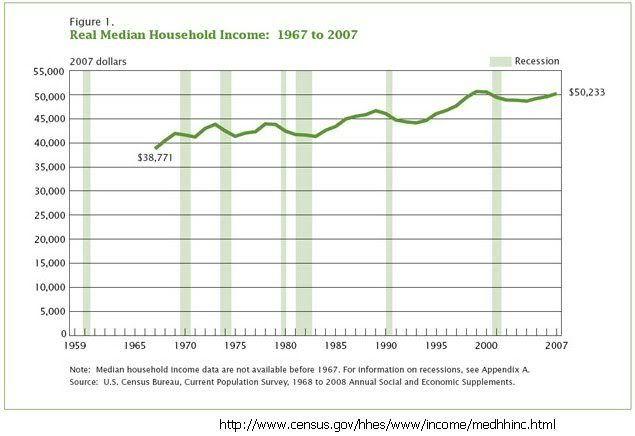
* Real median income declined by $1,860 from 2007 to 2008, a decline of 3.6%, the highest one-year decline in income on record.
* General poverty reached 13.2% in 2008, up from 12.5% in 2007 (and projected to be around 14% for 2009), which is its highest level in 11 years. This increase is because so much of our anti-poverty policies today are for paid work, and the so-called, “safety net” has been cut so much that it no longer does much when the job market is bupkis.
* The family poverty rate rose to 10.3 percent in 2008, up from 9.8 percent in 2007, and projected to be around 11% by the end of 2009.
* Median household income sank 3.6% to $50,303, after adjusting for inflation, and expected to drop at least 5% more this year. That’s more sharply than any time since the government began keeping records in 1947.

A partial racial and ethnic breakdown:

* Non-Hispanic Whites, 8.6 % (17.0 million people) in 2008—up from 8.2 % (16.0 million people) in 2007.
* Blacks, 24.7% (9.4 million) up from 24% in 2007.
* Asians, 11.8 % (1.6 million), up from 10.2 % (1.3 million) in 2007.
* Hispanics, 23.2 % (11.0 million) in 2008, higher than 21.5 % (9.9 million) in 2007. (The large decline in Hispanic income in 2008 is likely related to that group's concentration in the construction industry, which has collapsed due to the bursting of the housing bubble.)[2]

Health care
* Costs continue to soar and in 2008 46.3 million people were uninsured, which was up from 45.7 million in 2007.
* [The unrelenting increases are of course why something like a “Public Option” to force the insurance companies into being more competitive is an absolute necessity for true reform. Not to sound political here, but it is interesting that as more and more people lost their job-related policies and were unable to afford private plans, more and more of them joined the government-controlled, single payer, socialized health care plans. Medicaid and S-Chip climbed from 83.0 million to 87.4 million.

Those hurt worst by the recession
* Worst hit were middle-aged households headed by 45-54-year-olds. They averaged a 5.4% drop in income.
* The only group that actually gained during the last year were people 65 and older, who participate in a radical, socialized, communist inspired, government-run, single payer health care plan and a radical socialized government-run income supplement program. Their incomes rose modestly by 1.2%.[3]


Second, the numbers are even worse than they say they are. The Federal guidelines for assessing poverty are based on ancient, out-of-date assumptions that hide much of the reality of poverty. They were developed in the 1960s and assumed that the average family spent about one third of its income on food. They set the income level for poverty to be the cost of three times a basic market basket of food. (It was later adjusted to five times, but is still just based on food.) However, since then the costs of other things have skyrocketed. What about, for example, child care, gas, commuting, home energy, or housing? All of these items have risen as a percentage of our personal expenses while food has actually gone down. Housing used to be about ten percent of a family’s annual expenses. Now it’s more than thirty. What about health care, which has gone up about thirty-five percent faster than the cost of living and has become unfordable for millions. Also, the amount of disposable income that the average family keeps after taxes (income, payroll, sales, property, etc.) is far smaller today than it was in 1960. The point here is that when all of these things are factored in, the number of people in “real” poverty is often twice that of the official numbers.[4]

To be fair, the Census Bureau knows this (see their report cited in the notes) but cannot factor these things in until Congress tells them to and don’t hold your breath. Congress has never shown an interest in changing the poverty formula. My guess is that it is because they also will prefer using a lower poverty number over higher ones because it makes us look wealthier as a nation than we really are.

Third, we may be in for some dark and stormy nights for years to come.
If you read closely in the poverty statistics you noticed some scary trends. The most ominous is that from 1998 to 2008, median incomes in America went down from $51,295 to $50,303 for a family of four, and the number of non-farm jobs — roughly 131 million — pretty much flat-lined.[5] That includes the years in the decade when we were going through the “Bush Recovery” and the economy was supposedly booming. The only time when our incomes looked like they were rising was in the last couple of years of the fake money of the housing bubble and not real money. That “growth,” as we now know, was like the pea in the old shell games. The magician keeps shuffling the pea from shell to shell giving the impression that there were many peas and each shell had a pea in it, when in reality there was just one pea moving very, very fast (and getting very tired).

To make this even scarier, here are four trivia questions for you: First, when was the last time that we have gone that long without any perceivable rise in median incomes? The answer is, 1982. Second, when was the last time we had this dramatic an increase in poverty in one year: 1991. Third, when was the last time we had a drop of 5% in employment over a period of just nine months? That was back before World War II. And finally, when was the last time we had more than twenty-seven weeks in a row of rising unemployment? The answer is nobody knows. There has never been that long a run of high unemployment since the Bureau of Labor Statistics has been collecting numbers. And that is what should scare us.

What does all of this mean?
There is a rule of thumb in economics, called “Okun’s Law,” which means roughly that when the Gross Domestic Product (GDP) goes down, jobs go down with it, and when the economy goes up, jobs (eventually) go back up with it. With all of the stimulation and economic growth we’ve had in the last six months, the “law” says that we should have around 8.5 % unemployment today. That, however, was the number we passed on our way up to 10% about four months ago. For some reason that economists can’t quite explain, Okun is letting us down. Something in the economy is broken, maybe fundamentally. Jobs seem to be unhooked from economic growth.

Presidential economic advisor, Larry Summers, back in the eighties when he was a lowly labor economist, wrote an important article analyzing Japan’s economy which had been stagnant for over a decade. He said that there were mysterious occasions when something kept Okun’s law from working and employment became unhooked from the rise and fall of the GDP. He called it “Hysteresis.” It comes from a Greek verb meaning “to lack in something central.” You have seen the word in the New Testament a few times. In Mark 12:44, for example, a widow gives alms out of her “lack” (hysterseos). Paul once said in Philippians that while he wasn’t rich, he didn’t have any real “need” (husteresis).

[A different definition and etiology comes from “path dependence” meaning that the future is dependent upon the path. Once you get started in a path, the harder it is to get out of it.]

When applied to the economy, it means that something is mysteriously missing and things aren’t working the way they should, and because it’s gone, we may never be able to return to “normal” again. Something is broken and may not be fixable. In our situation, the economy is growing but jobs are not. Trying to fix that with the old tools of monetary or fiscal policies may miss the problem because what’s missing is a deeper and more structural shift in the entire way we have functioned as a country. The term was applied to Europe in the eighties, Japan in the nineties, and it may well apply to the U.S. in the 2000s and beyond.[6] If true, it means that the old jobs just aren’t going to come back. When new jobs are created, they are invariably of poorer quality than the old ones, a trend that has no apparent likelihood of changing.

Part of the problem is, of course, inevitable. That is, seven million people lost their jobs and it’s hard to pull back to “normal” after that. People now buy fewer groceries, which means the grocer buys less from distributors, who buy less from the wholesalers, who buy less from the manufacturers. And so on until you get down to the coffee farmer in Ethiopia who can’t sell his beans and he grinds them up for mulch to sprinkle around next year. This is a downward spiral, and cannot be fixed quickly, no matter how much stimulus money is spent, even if most of it actually went to job creation, which in our case it did not.

Imagine income in America as a foot ball field. The median income is the fifty yard line. The left goal posts are the most poor. The right goal posts are the Wall Street oligarchy who rake in two and three hundred million dollars a year. The red line represents what used to be a gradual line of income going upwards. http://www.lcurve.org/ZoomShots/Zoom5.gif

But another important part is hysteresis, a critical “lack” of something in our economy that has kept us prosperous for generations. One thing increasingly lacking is justice in our politics, power, and income distribution. For at least the last thirty years there has been dramatic income growth for the top and stagnation or decline for all the rest. On average, incomes have declined by 2.5 percent among the bottom fifth of families since the late 1990s, while increasing by 9.1 percent among the top fifth. That is a structural problem and a justice problem and it will not be fixed in our lifetimes because of the enormous influence that the wealthy have over the politicians whose re-election campaigns they fund. It’s hard for a Legislator to believe one way on an issue when his re-election is being paid for by a corporate PAC that believes another.

Inflation adjusted percentage increase in after-tax household income for the top 1% and the four quintiles, between 1979 and 2005 (gains by top 1% are reflected by bottom bar; bottom quintile by top bar).[7]
http://upload.wikimedia.org/wikipedia/en/a/a4/Income_gains.jpg

A second place where the concept of hysteresis applies is in what has happened to us with economic globalization. Our historic engines of economic growth are crumbling with the advancement of international trade and nothing so far is taking their place. It is an interesting fact that whenever there has been an increase in trade, the gap between rich and poor has gotten larger with more power concentrating at the top and less at the bottom. In the most recent 25-year run of global trade (starting roughly in the early 1980s), some have become winners but many are losers. That has been true since ancient Israel traded wine for wood with its Phoenician neighbors to the north[8] and it hasn’t changed much today.[9] The spoils of trade flow upwards and with them come power and influence. That disparity will be a blight on democracy and our economic development for many, many years to come.

We are a country that became rich on small farms and big industry. Neither are sustainable any longer and we haven’t invented a new model to take their place. Since the thirties small farms have been getting larger and since the seventies industry is getting smaller. We don’t have the will to pay living wages to factory workers while China has millions of poor and starving people willing to make the same items for a dollar a day. It may very well mean that high paying jobs for middle class America are gone forever—or at least for a generation. Joe Stiglitz, speaking at a conference in Pittsburgh just before the meeting of the G-20 last week said that the American economy needed to expand at a rate of 3.2 percent a year to create more jobs than we are losing, and there was nothing visible on the horizon for many, many years that could make that happen. Something is broken in the economy and nobody knows how to fix it.

As you probably know, the U.S. manufacturing base began moving from the northeast to the south about forty years ago. Then in the mid-nineties, with NAFTA, it moved over the border to Mexico. Then beginning in 1999, when China joined the WTO, it began moving from Mexico to China. And manufacturing will probably continue to grow there for generations more. China is so large and poor and undemocratic that it will take multiple decades before its people are free enough to demand living wages. And when that happens, manufacturing will start searching out other poor countries for production. By then the U.S. will have dismantled its entire manufacturing base and suffered through profound emotional and social changes making the transition. It is unlikely that we will ever be the wealthy country we were just twenty years ago. Now, that may not be bad in terms of global justice and a vision of God’s peaceable realm. The U.S. has had too much wealth and too much power for far too long. And the damage done to the environment to keep us there is unconscionable. However, this kind of rapid re-alignment of power never comes without wrenching pain and hardship for those going through it. And as people of faith we need to gear up for a long, hurting period where our wisdom, compassion, and pastoral skills will be tested. In addition, power never gives up its perch without inflicting pain on those around it on the way down. So, look for continued punitive bitterness and reprisals from the wealthy (and those who identify with them) as they try to maintain their wealth and privilege.

How should people of faith respond to these inevitable hardships? What are the issues that our churches should become involved in to help direct the changes in more humane and environmentally friendly directions? Those well may be the most important questions that churches and faith groups will be asking themselves for the next generation.

P.S.
I’m working on an article right now with some biblical reflections on that. It includes discussions of Jesus on goods and services distribution, the Apostle Paul on the establishment of a functioning regulatory framework for trade, and Moses on derivatives trading. I’ll post a draft of it next week and I would very, very much appreciate your thoughts and comments. It’s half tongue-in-cheek, of course. There’s not much in the Bible that has to do with derivatives or credit default swaps, but I do think there are a few faithful, biblically grounded principles for a progressive response to the long-term poverty prospects that loom out in front of us. And I’d like to draw out a few of them for your comments.

In the meantime, print out this post, write the word “bleak” all over it and go drink a cup of coffee.

Notes:
[1] Carmen DeNavas-Walt, Bernadette D. Proctor, Jessica C. Smith Income, Poverty, and Health Insurance Coverage in the United States: 2008 (U.S. Census Bureau P60-236(RV): September 2009).
[2] Heidi Shierholz, “New 2008 poverty, income data reveal only tip of the recession iceberg” (Washington, DC: Economic Policy Institute, September 10, 2009), http://www.epi.org/publications/entry/income_picture_20090910.
[3] Stephen Lendman, “US Census Bureau Confirms Rising Poverty, Falling Incomes, and Growing Numbers of Uninsured: Wall Street is improving but Main Street is worsening in every way. (The Baltimore News Network/Baltimore Chronicle), September 14, 2009.
[4] Shawn Fremstad, Measuring Poverty and Economic Inclusion: The Current Poverty Measure, the NAS Alternative, and the Case for a Truly New Approach, Washington, DC: Center for Economic and Policy Research, December 2008.
[5] David Leonhardt, “A Decade With No Income Gains” (New York Times, September 10, 2009) http://economix.blogs.nytimes.com/2009/09/10/a-decade-with-no-income-gain; Clive Corcoran, “U.S. Median Income from 1999-2009: No Gain, Much Pain,” Seeking Alpha, September 13, 2009, http://seekingalpha.com/article/161271-u-s-median-income-from-1999-2009-no-gain-much-pain?source=article_lb_articles.
[6] Joshua Cooper Ramo, “Jobless in America: Is Double-Digit Unemployment Here to Stay?” Time Magazine, Friday, Sep. 11, 2009, p. 45.
[7] Source: Aron-Dine, A. & Sherman, A. “New CBO Data Show Income Inequality Continues to Widen: After-tax-income for Top 1 Percent Rose by $146,000 in 2004” (Center for Budget and Policy Priorities: January 23, 2007), p. 2.
[8] Roland de Vaux, Ancient Israel Vol. 2 (New York: McGraw-Hill, 1965), p. 481.
[9] See for example, Mark Weisbrot, Robert Naiman, and Joyce Kim, The Emperor Has No Growth: Declining Economic Growth Rates in the Era of Globalization (Washington, DC, Center for Economic Policy Research, November 27, 2000). Also, Aron-Dine, A. & Sherman, A. op.cit., pp. 2-4.

The Continuing Disaster of Wall Street, One Year Later

by Robert Reich

Robert Reich is a professor at the University of California at Berkeley and a former U.S. Secretary of Labor.

Week of 9.18.09

As he attempted to do with health care reform last week, the President is trying to breathe new life into financial reform. He’s using the anniversary of the death of Lehman Brothers and the near-death experience of the rest of the Street, culminating with a $600 billion taxpayer financed bailout, to summon the political will for change. Yet the prospects seem dubious. As with health care reform, he has stood on the sidelines for months and allowed vested interests to frame the debate. Nor has he come up with a sufficiently bold or coherent set of reforms likely to change the way the Street does business, even if enacted.

Let’s be clear: The Street today is up to the same tricks it was playing before its near-death experience. Derivatives, derivatives of derivatives, fancy-dance trading schemes, high-risk bets. “Our model really never changed, we’ve said very consistently that our business model remained the same,” says Goldman Sach’s chief financial officer.

The only difference now is that the Street’s biggest banks know for sure they’ll be bailed out by the federal government if their bets turn sour—which means even bigger bets and bigger bucks.

“As with health care reform, [President Obama] has stood on the sidelines for months and allowed vested interests to frame the debate.”

Meanwhile, the banks’ gigantic pile of non-performing loans is also growing bigger, as more and more jobless Americans can’t pay their mortgages, credit card bills, and car loans. So forget any new lending to Main Street. Small businesses still can’t get loans. Even credit-worthy borrowers are having a hard time getting new mortgages.

The mega-bailout of Wall Street accomplished little. The only big winners have been top bank executives and traders, whose pay packages are once again in the stratosphere. Banks have been so eager to lure and keep top deal makers and traders they’ve even revived the practice of offering ironclad, multimillion-dollar payments - guaranteed no matter how the employee performs. Goldman Sachs is on course to hand out bonuses that could rival its record pre-meltdown paydays. In the second quarter this year it posted its fattest quarterly profit in its 140-year history, and earmarked $11.4 billion to compensate its happy campers. Which translates into about $770,000 per Goldman employee on average, just about what they earned at height of boom. Of course, top executives and traders will pocket much more.

Every other big bank feels it has to match Goldman’s pay packages if it wants to hold on to its “talent.” Citigroup, still on life-support courtesy of $45 billion from American taxpayers, has told the White House it needs to pay its twenty-five top executives an average of $10 million each this year, and award its best trader $100 million.

“The mega-bailout of Wall Street accomplished little. The only big winners have been top bank executives and traders...”

A few banks like Goldman have officially repaid their TARP money but look more closely and you’ll find that every one of them is still on the public dole. Goldman won’t repay taxpayers the $13 billion it never would have collected from AIG had we not kept AIG alive. (In one of the most blatant conflicts of interest in all of American history, Goldman CEO Lloyd Blankfein attended the closed-door meeting last fall where then Treasury Secretary Hank Paulson, who was formerly Goldman’s CEO, and Tim Geithner, then at the New York Fed, made the decision to bail out AIG.) Meanwhile, Goldman is still depending on $28 billion in outstanding debt issued cheaply with the backing of the Federal Deposit Insurance Corporation. Which means you and I are still indirectly funding Goldman’s high-risk operations.

So will the President succeed on financial reform? I wish I could be optimistic. His milktoast list of proposed reforms is inadequate to the task, even if adopted. The Street’s behavior since its bailout should be proof enough that halfway measures won’t do. The basic function of commercial banking in our economic system—linking savers to borrowers—should never have been confused with the casino-like function of investment banking. Securitization, whereby loans are turned into securities traded around the world, has made lenders unaccountable for the risks they take on. The Glass-Steagall Act should be resurrected. Pension and 401 (k) plans, meanwhile, should never have been allowed to subject their beneficiaries to the risks that Wall Street gamblers routinely run. Put simply, the Street has been given too many opportunities to play too many games with other peoples’ money.

“[President Obama’s] milktoast list of proposed reforms is inadequate to the task, even if adopted.”

But, like the health care industry, Wall Street has platoons of lobbyists and an almost unlimited war chest to protect its interests and prevent change. And with the Dow Jones Industrial Average trending upward again—and the public’s and the media’s attention focused elsewhere, especially on health care—it will be difficult to summon the same sense of urgency financial reform commanded six months ago.

Yet without substantial reform, the nation and the world will almost certainly be plunged into the same crisis or worse at some point in the not-too-distant future. Wall Street’s major banks are already en route to their old, dangerous ways—now made more dangerous by their sure knowledge that they are too big to fail.


http://www.pbs.org/now/shows/538/reich-wall-street.html

US Census Bureau Confirms Rising Poverty, Falling Incomes, and Growing Numbers of Uninsured

Wall Street is improving but Main Street is worsening in every way.

by Stephen Lendman
Monday, 14 September 2009

In early September, The US Census Bureau released its new report titled, "Income, Poverty, and Health Insurance Coverage in the United States: 2008" showing disturbing data that portends much worse ahead under a president and Congress doing nothing to address it.

In 2008, poverty reached 13.2% of the population, its highest level in 11 years, the result of millions losing jobs during the first year of the gravest economic crisis since the 1930s. For blacks, the figure was nearly double at 24.7%, and 31% of all Americans were impoverished for at least two months between 2004 and 2007, years of economic expansion.

At yearend 2008, even by the Bureau's conservative measures, 39.8 million people were impoverished, the highest level since 1960, and 17.1 million lived in extreme poverty at below one-half the official threshold. In addition, for the first time since the 1930s, median household income failed to increase over a 10-year period from 1999 - 2008.

The Census Bureau states that it "presents annual estimates of median household income and poverty by state and other smaller geographic units based on data collected in the American Community Survey (ACS)" covering population areas of 20,000 or more. The Bureau's Small Area Income and Poverty Estimates (SAIPE) program also produces yearly figures "for states and all counties, as well as population and poverty estimates for school districts." It uses data from a variety of sources, including surveys, administrative records, inter-censal population estimates, and personal income data published by the Bureau of Economic Analysis.

Critics maintain that official government figures way understate the gravity of today's crisis, and the Bureau says:

"The official poverty thresholds were developed more than 40 years ago and have been criticized for not taking into account rising (or since the 1970s inflation-adjusted falling) standards of living, expenses such as child care that are necessary to hold a job, variations in medical costs across population groups (that have skyrocketed nationally and are now unaffordable for millions), and geographic differences in the cost of living."

In addition, income and poverty estimates are pre-tax and exclude non-cash benefits, usually employer-provided. Disposable personal income, after income, payroll, sales, property and other taxes, reveals a far higher poverty level than the Census Bureau reports and a much graver crisis for growing millions as the economic decline deepens.

The Bureau reported that 2008 median (inflation adjusted) household income fell 3.6%, the largest single-year decline on record to the lowest level since 1997 and falling as conditions continue to worsen.

The plight of the poor and impoverished shows up in numerous other reports that paint a darker picture than the Census Bureau and suggest much worse ahead:

  • an unprecedented, growing disparity between the very rich and other income groups;
  • economists Thomas Piketty and Emmanuel Saez's research showing the top 1% of households got two-thirds of the national income growth during the last recovery, a larger share than at any time since the 1920s;
  • wages losing ground to inflation;
  • millions of children dependent on school lunches for a hot meal;
  • an Economic Policy Institute estimate of one-quarter of all children living in poverty by yearend 2009;
  • the continued erosion of employer and government-provided benefits, including at the state and local levels; the growing uninsured crisis is discussed below;
  • greater numbers of households unable to meet expenses, even with two working members;
  • added duress from state budget cutbacks;
  • record numbers of food stamp recipients;
  • persistent and growing hunger and homelessness; and
  • job losses and higher unemployment continuing for many more months with some analysts projecting record high numbers before peaking.

A September 11 Kissinger Associates Joshua Ramo story in Time magazine highlighted the problem. Titled, "Jobless in America: Is Double-Digit Unemployment Here to Stay," it quoted Larry Summers' remarks last July before the Peterson Institute for International Economics about the disturbing rate of job losses. He suggested something strange was happening, unpredicted by experts:

"I don't think that anyone fully understands this phenomenon," he said. Will job losses mount longer than expected? At the "recession's" end, will low numbers of new ones follow, and will double-digit unemployment persist and remain common?

Without saying it, Summers wondered if America's economic model was broken, and if so how to fix it. Or can it be fixed? According to the Peterson Institute's Jacob Kirkegaard, "It is entirely possible that what started as a cyclical rise in unemployment could end up as an entrenched problem."

Summers earned his reputation as an employment theorist. He now believes that earlier unemployment views are "importantly wrong. I thought if you could have areas where there was long-term substantial unemployment, then that raised some questions about the functioning of markets."

In 1986, he wrote an article titled, "Hysteresis and the European Unemployment Problem." Hysteresis is the Greek word for late, referring to what happens when something snaps and can't be fixed. It's an idea economists deplore applying to economies, preferring instead to cite normal business cycle ups and downs. Yet in 1986, Summers argued that Europe's unemployment might be chronic and persist in times of growth.

Today's are another matter at a time of a changing economic landscape perhaps suggesting that hysteresis is confronting America, and many lost jobs aren't coming back, especially better paying ones. That's Kirkegaard's view in saying growth won't put Americans back to work, and new jobs created will be poorer quality than old ones.

So what can be done going forward? Unlike in the 1930s, machines now do much of the work that people did then on infrastructure projects. And it's a lot harder converting white collar workers to blue collar ones. Moreover, Summers' own research concludes that the traditional Western economic model won't alleviate the jobs crisis, so what will?

Summers won't say it, but short of a total remake of "free market" economics, likely nothing and perhaps that's America's future with growing millions consigned to a permanent underclass, while an elite few at the top grow richer, until one day "hysteresis" snaps the system in a disruptive convulsion, the old model passes from the scene, and nothing is the same again.

More Evidence of Economic Duress in the Latest Federal Research Report on Consumer Credit

On September 8, the Federal Reserve reported that total consumer credit fell by a record $21.6 billion in July (the sixth consecutive monthly decline) and year-over-year by $2.47 trillion or 10.4%. According to Bernard Baumohl, The Economic Outlook Group's chief global economist:

"It is one more important sign that consumers are not going to be contributing very much to the economy for the balance of this year and probably for (at least) a good part of next year." Shrinking credit's impact on consumption indicates an economy in decline. It shows up in growing poverty, falling incomes, and greater duress for growing millions, sure to be reflected in the Bureau's 2009 report.

Continued Erosion of Health Care Coverage

In 2008, the Bureau also collected data on health insurance coverage, putting the number of uninsured at 46.3 million last year (15.4% of the population), or an increase of 682,000 over 2007. It was the eighth consecutive year that fewer workers got employer-provided coverage, and those with it had to pay more of the cost.

Other estimates are far grimmer. Some, including the Congressional Budget Office, place the current uninsured total at about 50 million, and a May 2009 Todd Gilmer - Richard Kronick study estimated that 191,670 more lose coverage monthly, 2.3 million annually at the present rate, and an expected 6.9 million more Americans (over 2007) will lack it by yearend 2010 if the present trend continues.

Add to these the underinsured. According to the American Public Health Association, at least another 25 million at great risk if they face a serious health problem not covered by their present plan. In addition, Families USA estimates about 90 million Americans had no health insurance during some portion of 2007 or 2008. The Henry J. Kaiser Family Foundation reported that over 80% of the uninsured come from working families, and the Agency for Healthcare Research and Quality estimated that 27% of under aged-65 year old Americans lack coverage.

Still other estimates project up to 60 million uninsured if the commonly reported U-3 unemployment rate hits 10%, and the Urban Institute sees around 66 million without coverage by 2019, given the present trend of rising costs forcing employers increasingly to cut back.

Bureau data show that coverage weakened across most sectors of the population, including full-time workers and the middle class, the result of economic decline and years of employers putting a greater burden on their workforce.

Since at least 2001, the percent of workers with employer-provided insurance has steadily eroded, and it's the main reason behind growing numbers of uninsured and underinsured. In 2008, 61.9% of the below-aged 65 population had job-provided coverage, down from 67% in 2001 and falling due to cost cutting, continued job losses, and the trend to lower-paying ones.

In addition, holding a job no longer guarantees coverage. Plans offered have been greatly eroded, and medical expenses today are the leading cause of personal bankruptcies. America is the world's only industrialized country denying its citizens universal coverage, yet spends on average more than double the other 30 OECD countries and delivers less for it because of unaffordable private insurance and overpriced drugs.

Nothing being debated in Washington addresses this, so whatever legislation emerges will make a dysfunctional system worse with the American public betrayed by "a slick-talking street hustler"- what analyst Bob Chapman calls Obama, or according to James Petras, "the greatest con man in recent history." Make that plural with Congress under Democrat or Republican leadership because both parties are beholden to the corporate interests that own them and are indifferent to growing public needs.

Since taking office in January, Obama kept reform off the table, made progressive change a nonstarter, and achieved the impossible by governing worse than George Bush on virtually all of his domestic and foreign policies.

Since taking office in January, Obama kept reform off the table, made progressive change a nonstarter, and achieved the impossible by governing worse than George Bush on virtually all of his domestic and foreign policies. Along with looting the federal Treasury, wrecking the economy, selling out to Wall Street, and continuing imperial wars, Obamacare is the centerpiece of his failed agenda and a betrayal of the public's trust.

On September 9, he presented his vision to a joint congressional session, reassuring providers that their interests are secure. Rejecting universal single-payer coverage, he said it "makes more sense to build on what works and fix what doesn't, rather than try to build an entirely new system from scratch." And while favoring a "public option," he assured private insurers that it's not a deal-breaker, guaranteeing that no final plan will include one because enough votes can't be gotten in the Senate.

Key also is lowering costs by:

  • cutting hundreds of billions in Medicare and Medicaid benefits as a prelude to eliminating or greatly gutting these programs with perhaps Social Security and other social gains to follow;
  • placing caps on what tests and treatments doctors can provide;
  • putting "medical expert" gatekeepers in charge of deciding the most cost-effective care, thus preventing doctors from prescribing what's best for their patients and denying people the right to make their own health care choices if their cost exceeds what Washington will allow;
  • taxing so-called "Cadillac" plans (mostly covering state employees, municipal union members, and other working Americans, not just the super-rich) to encourage employers to provide fewer benefits, thus placing a greater burden on workers; forcing everyone to have insurance; and placing a surtax on non-compliars with incomes of between 100 - 300% of the poverty level under the Baucus Senate plan;
  • creating a "deficit trigger" to reduce the growth of Medicare and Medicaid spending if anticipated savings aren't met; and
  • making everyone more responsible for their own care by forcing them to cover more of the cost in return for less coverage when they need it most.

Numerous details remain hidden from the public, but the goal of Obamacare is clear. It's a scheme to ration care; charge people more for it; enrich private insurers, PhRMA, and large hospital chains; mandate insurance for everyone; and penalize non-compliars. It's up to public outrage to stop it.


Steve Lendman

Stephen Lendman is a Research Associate of the Centre for Research on Globalization. He lives in Chicago and can be reached at lendmanstephen@sbcglobal.net.

Also visit his blog site at sjlendman.blogspot.com and listen to The Global Research News Hour on RepublicBroadcasting.org Mondays from 11AM to 1PM US Central time for cutting-edge discussions with distinguished guests on world and national topics. All programs are archived for easy listening.

Mr. Lendman's stories are republished in the Baltimore Chronicle with permission of the author.


Copyright © 2009 The Baltimore News Network. All rights reserved.

More on "Who Knew" About the Coming Crash


Financial Regulators Held Secret Meeting With Hedge Fund Short Sellers In 2007

John Carney|Aug. 26, 2009, 8:40 AM|
http://www.businessinsider.com/financial-regulators-held-secret-meeting-with-hedge-fund-short-sellers-in-2007-2009-8

The Evening Standard's Paul Waugh reveals today that G7 finance ministers were warned about the dangers of US subprime loans and shaky banks back in April 2007. Famous hedge-funders Jim Chanos and Paul Singer sounded the alarm but were completely ignored.

From Waugh:

Chanos has now revealed that the pair of them warned of "radioactive" securitisations held by banks - and even named those his firm was shorting. But they were "officially ignored" by the G7 ministers.

Chanos picks up the story (forgive me quoting at length but it's worth it):

"It was the April 07 G7 Finance ministers meeting in Washington. It was a rotating chair and the Germans were rotating the meetings. And at the time if you recall the Germans were quite concerned about hedge funds and private equity as being a future source of problems in the market place.

"And Bob Steel, who was the Under-Secretary to the Treasury, who was fighting these German efforts at the time, felt that it would be helpful if two hedge fund managers came down and address the finance ministers and central bankers on the last day. So I was invited along with Paul Singer, who has gone public now, he was the other manager.

“Paul got up and proceeded to give a tour de force presentation on the coming crack-up in structured finance, how all these structures were very unstable and triple A [the ratings given to the securities] was not going to be triple A..."

The meeting was just five months before the run on Northern Rock and more than a year before Lehman Brothers collapsed.

Chanos and Singer pointed out that HSBC had announced that January that its US sub-prime loans were going bad at 'an alarming rate'.

“So there were some canaries in the coal mine by April 07 and Paul pointed them out,”

"I then segued into my presentation which told the assembled regulators that in fact if Mr Singer was correct and I believed he was, that the problem would not be hedge funds it would be the regulated banks and brokers who were leveraged 30-1, many of which held glowing, toxic radioactive pieces of securitisation which they could never sell.

"The German finance minister who was chairing the meeting thanked me politely and then thanked Paul and said 'so what do you think about Hedge Funds?'“

So despite having received this stark warning, the only response from the politicians was 'yeah, yeah but what about tightening up regulation on you guys?'

Mr Chanos, founder of Kynikos Associates, said that immediately after the presentation, the G7 ministers issued a statement continuing to insist that their economies were strong and made no mention of the warnings. Check out the G7 Communique of the time - you won't find a clearer example of the complacency of world politicians and regulators.

“We were completely and officially ignored,” said Chanos.