From Jubilee to the World Bank

For the next few weeks posts to this blog will be chapters of my upcoming book, From Jubilee to the World Bank: Economic Globalization for Faith-based Activists. Please feel free to send me feedback.

Stan Duncan


INTRODUCTION


This book is essentially about three things: economic globalization, the international debt crisis, and faith. By “faith,” more specifically I mean possible responses of the faith communities to the first two topics. It is intended as a helpful handbook of concepts and histories about some of the major international economic justice issues of our time, and faith-full ways that we can be involved, become activists, and make a difference.

Is this a “Religious Book”?

In spite of the occasional use of economic jargon, especially in the first section, this is still a fundamentally religious book. Most of the chapters were written originally for local church congregations and not for people with previous in depth knowledge of economics.

However, there is more to writing from a religious perspective than including Bible studies and sermon notes. The Bible is enormously complex and how one understands its origins and meaning has much to do with how it can help us in our contemporary moral, ethical, and political decision making.

There are two types of writings in the Bible that may be of most help to us as interpreters of contemporary issues. The first are parallels and the second are principles, and they should be distinguished. Parallels are stories (historical or in parables) of hunger, or poverty or oppression which, however roughly, parallel conditions in our world today. Examples would be stories of the rise of poverty and social unrest in ancient Israel that grew as its own involvement in international trade grew. We could ask then, what did the Prophets say about that? How did the oppressed and those who aligned themselves with the oppressed respond to it? The answers to those questions can be helpful in understanding and critiquing current situations. Principles, on the other hand, are broader, more general interpretive teachings or paradigmatic stories that give us guidance in a larger sense. A frequently used example is the story of God through Moses liberating the Hebrew people from slavery in Egypt. A principle based on that story is that since God freed us, it is therefore our duty and responsibility to free others. This thread is found throughout the Bible, especially in Exodus and Deuteronomy and the teachings and parables of Jesus, and has had a profound influence on liberation movements all over the world.

So, while it is true that the Bible will be of little help if we are trying to decide how high to set the Federal Reserve overnight discount rates or whether there should be a tax on currency exchange rates, it can and should give us guidance on a larger perspective we as people of faith should have when making those decisions ourselves. If we believe, as the Bible seems to believe, that God has a special interest in the poor, the weak, and the oppressed, then the first questions people of the Bible should be asking themselves are: how many marginalized and weak people will be hurt or helped by this or that policy? How many wealthy and powerful will it help? If the policy is designed to bail out banks, for example, by cutting price supports for third world farmers, then it is probably a policy that stands outside of our biblical and faith tradition.

Why This Book Now?

At the time this book was being written, the US was rapidly sliding into a deep recession that lasted for months and its after-effects for years. One thing that was different in this recession from many others in the past was the intense interconnectedness of our global economies. That means that today, when the US sinks the rest of the world sinks with it. Our problems and mistakes will be carved on the foreheads of suffering children in hundreds of countries, and decisions that leaders of their countries make will impact whether we fall as a nation or just stumble temporarily. We are all related. The saying that when a butterfly bats its wings in Taiwan a monsoon is caused in Brazil, has never been more true. Today we might change the saying slightly to say that if brokers on Wall Street make gambles on commodity futures, cotton farmers in Bangladesh starve. They speculate on the future price of commodities taking them off the market, which drives up the price (called “forward-pricing”) making them pinch for the rich and unavailable to the poor. Similarly, when China eats more meat, poor city dwellers go hungry. That is, the recent growth in the standards of living in China meant more people wanting to imitate the rich and eat beef (the food of the rich) and beef takes two hundred pounds of grain to feed a cow for every one hundred-seventy-five pounds of meat. So, the more meat China eats, the less grain there is on the market. The less grain on the market, the higher its price. The higher its price means the higher the level of hunger in the world. This complex web of interlocking economic, political, and ideological forces means that more than at any other time in our history we are all winning or losing together.

One of the difficulties with the connections between these cause and effect linkages is that people who are affected by them seldom see them. During the nineties and early years of this decade, for example, small coffee farmers in the Alto Occidente region of Colombia experienced a rapid decline in profits, which drove thousands of them from their homes and farms and into the harsh ghettos surrounding Bogotá looking for work. For the most part they had no way of knowing that much of their catastrophe was caused by decisions made by bureaucrats in international banks and multilateral financial institutions thousands of miles away who promoted far too many loans for coffee production, and which eventually drove down profits for individual farmers everywhere.

More recently, during the global food crisis, how many of the tens of thousands of people who protested the soaring prices realized that at least one of the causes of their misery was geopolitical and ideological? During demonstrations in Haiti in March, 2008, five people died (including a UN staff member), the government fell, the prime minister was ousted, the World Bank rushed in with loans for more food, and the World Food Programme called for international aid. There are a number of reasons for the increases, but one of them began a decade ago when the US pressured Haiti to drop its tariffs on imports, such as rice, in order to allow in subsidized US rice, which then destroyed Haiti’s rice farmers, and forced Haitian consumers to become dependent upon imported rice. Then, in 2007, the price of US rice went up to triple digit highs, and people in Haiti began to experience absolute starvation for the first time in decades. How many hungry people in Haiti can connect the dots to see how their individual story fits into the global story?

Seldom do they see the connections between their small stories of poverty and the much larger stories of greed and finance. “Hardly anyone tells them that they are victims of a whole interconnected system extending all over the globe and varying only in degree,” says German biblical scholar Ulrich Duchrow. Because “If they heard, they might join forces!”[i] With the possibility of a looming global famine, one that touches the developed world as well as the undeveloped, we may for the first time in history be witnessing a time in which the poor and hungry do in fact begin to join forces.

People of faith need to work harder at making these connections and helping our churches learn them. Part of what comes from a belief in the God of all creation is a commitment to push ourselves to view issues “from above” and not just “from below.” That is, we need to lift our perspectives from a “me first” level to as high as our human limitations can take it. Part of what happens when my life is intertwined with the life of the mysterious savior from Nazareth is that I am no longer concerned with solely my own life but also with the lives of the rest of the family of God.

Additionally, the church is one of the few institutions still existing that has the perspective and ability to offer a sustained moral critique of the political and market forces that are tearing us apart. Churches and other religious organizations need to help people make those connections and to face up to its own responsibility for the damage done. Perhaps we have fallen down on that task because we are too complicit in the crime. Perhaps we subconsciously feel it would hurt too much and cost too much. But it has to be done.

To be fair to our human frailties, this is an enormously difficult task. The media will not help. The politicians who set the national conversation agenda will not help. Their re-elections are financially tied the very people who wish to keep these kinds of connections a secret. Only such things as diligence, persistence, study, advocacy, and faithful commitment to see the issues from above and people from love will do it. The Holy Spirit is not on the side of oppression or starvation. The Holy Spirit is on the side of liberation, democracy, wholeness, and the abundant life.

Obviously this one book or others like it cannot do everything. But what we can do is to supply some of the background material that might help the reader understand the framework of the various global economic forces and make some of the connections between what happens “here” and what happens “there.” Plus, in the second half of this book we will offer resources for Bible study and worship, and research and advocacy for the ongoing justice life of a church and faith community. We all must start somewhere.

Is This Book Biased?

The short answer is yes. But it’s more complicated than that. First I want to say firmly that there is much about economic globalization (and globalization in general) that is positive. I believe it is beyond debate that today’s rapid, global movement of goods and services can—and in many cases does—help feed the poor, increase democracy and lower human rights abuses. One of the most accessible books that makes that case with numerous heartening and engaging stories is Thomas Friedman’s The Lexus and the Olive Tree.

On the other hand, I also believe that all writing is biased. Friedman’s work is biased toward globalization, just as David Korten’s When Corporations Rule the World (as one can tell from the title) is biased against it. The truth is that globalization is a mixed bag. In addition to its frequently proclaimed values, there is much about it—at least in the form that it is now evolving—that is damaging both in poor countries and in rich. For example, the present reigning model of globalization requires a constant downward pressure on wages that results both in the increased poverty of workers and the increased mobility of corporations seeking cheaper wages. This darker side of economic globalization is seldom discussed on the business pages of our local papers. Until it is forced upon them through protests or presidential primaries, our national leaders and the mainstream media rarely comment on the loss of jobs in the US, many of which are directly related to NAFTA and other trade deals. And when they do, they almost never discuss whether NAFTA has been good or bad to poor communities in Mexico or other countries that have followed the free market economic formula. Therefore, though parts of these essays may seem to over-emphasize the negative aspects of globalization, in actual fact they are an attempt to bring balance to a story that most people have been told has only a positive side.

Having said that, it is also true that not much of the following will make sense unless the reader accepts the premise that there is something fundamentally wrong with our present global economic situation, that the corporate and political powers have contorted and stacked the decks of the financial machinery that runs the earth in such a way that rewards the rich and extracts payments from the poor. I will attempt to bring together evidence as we go along that will (in my opinion) make that case, but if you begin with the belief that things are fine and getting better (and that it will get better faster if the critics will just get out of the way and let the unregulated “free” market function) then most of what appears like evidence will be nonsensical.

We also need to agree that the Bible and Christian theology still have something to say to this situation. There are a number (in fact a growing number) of people who accept that the world’s economy is dangerously skewed, but who also believe that religion is unhelpful to that issue, and may in fact be a contributor to the crisis. I don’t believe that, and this work reflects a fundamental belief that we can find tools and insights to address our present situation in the stories and theological traditions of the Bible.

It is worth noting again that there are also clear biases in the existing rules of international finance. There does exist an ideology of inequality that drives the creation of the rules and by which the international financial system itself is ruled. The wealthy have not created this system which benefits them because they are mean evil people. They’ve done so because it is human nature to look out for oneself and one’s class. It is not always evil (though, undeniably occasionally). Sometimes it is simply a blindness driven by class or race or gender. Once one has sworn allegiance to a god other than the God of all creation, then the rest is less voluntary. Worshiping gods of wealth and power and influence can become an authentic bondage, a bondage that blinds one from seeing and feeling reality and blocks that reality from surfacing in one’s consciousness.


[i] Ulrich Duchrow, Alternatives to Global Capitalism: Drawn from Biblical History, Designed for Political Action. Tr. Elaine Griffiths…et al. (Utrecht: International Books: 1995), p. 12, pp. 15-16.

A $1 Trillion Answer

New York Times
November 30, 2008
Op-Ed Contributor | Transitions

WHAT President-elect Barack Obama will need to do is horribly complicated but also very clear.

First, he must stop the economy from going deeper into recession. Then he needs to bring about a robust recovery, preferably in ways that support the long-term needs of the United States: by repairing our neglected public works, invigorating our technological leadership, making our society greener, fixing our health care problems, healing our social and economic divide, and restoring our social compact.

It will not be easy. President Bush’s legacy of debt and the opposition of those who benefit from the status quo present major obstacles.

There is an emerging consensus among economists that a big — very big — stimulus is needed, at least $600 billion to $1 trillion over two years. Mr. Obama’s announced goal of 2.5 million new jobs by 2011 is too modest. In the next two years, almost four million workers will enter the labor force — or would if there were jobs. Combined with the loss of employment this year, that means we should be striving to create more than five million jobs.

A large stimulus package can always be trimmed later if it’s not needed because the economy returns to health faster than most economists think. But we need to plan for what looks to be a deep and long downturn. By relying heavily on automatic stabilizers — expenditures like increased unemployment benefits and revenue sharing with states — we can dose out the medicine as needed. The deeper and longer the downturn, the greater the spending.

Faint measures would be foolhardy. A weaker economy will suffer lower tax revenues, more foreclosures and more bankruptcies. Once a firm is bankrupt, you can’t unbankrupt it by providing a stronger stimulus later on.

There are other elementary principles that help guide the design of a good stimulus. The government could, for instance, temporarily pay (through a tax credit) part of the cost of new private investment for companies that are spending more than, say, 80 percent of what they have spent annually in recent years on equipment like computers and machinery. This would be a high-powered, low-cost stimulus.

Latter-day Hooverites will say the soaring deficit and national debt mean we cannot afford a large stimulus package. Although today they are receiving billions of dollars in aid, once they have their money some from the financial sector will argue that the economy won’t recover unless confidence is restored, and that confidence won’t be restored until the deficit narrows.

But it’s impossible to restore confidence when the economy is in shambles. When millions of Americans are out of work and hundreds of thousands of businesses are going into bankruptcy, there will be no “confidence.” This is the reality. To avoid this, we need a big stimulus.

But what you do with the money counts, too. The money needs to be spent carefully to ensure that every dollar provides as much stimulus now as possible while also contributing to long-term growth. That is why it is imperative to restructure the Troubled Asset Relief Program. Treasury Secretary Henry Paulson has already given away close to half of the $700 billion on very generous terms and without adequate restrictions on the use of the money.

The intent of the program was not just to give money to banks but to get them to increase lending. It has not worked, so it needs to be changed. If taxpayers pour our hard-earned money into banks, then the banks should not be allowed to pour out the money as dividends to their shareholders or bonuses to their executives. Nor should they be allowed to use the cash to purchase healthy banks, in further efforts to become “too big to fail.”

The Obama administration should not treat Mr. Paulson’s plan as immutable simply because “a deal is a deal.” The banks knew there was a quid pro quo. Besides, the terms of the relationship between the banks and the government (including the Federal Reserve) have repeatedly been adjusted, though almost always in favor of financial companies. The Fed used to accept only Treasury bills as collateral when it lent to banks. Now it accepts risky assets — junk.

Americans are rightly afraid of losing their jobs, and with that, their health insurance and their homes. We need to provide health insurance to the unemployed and to the uninsured, and we need to do it quickly, possibly through an expanded and more efficient Medicare.

We also need to stem the flood of foreclosures. If we help poorer homeowners, banks will benefit, too, as foreclosures are reduced. Through tax deductions, the federal government pays as much as 50 percent of the mortgage costs of upper-income Americans. If we treated the poor just as well as we treated the rich, more would find housing affordable.

And we need to change the bankruptcy laws to help homeowners. We have expedited bankruptcy for businesses, to keep them going when they run into financial problems. We should do the same for homeowners. It does no one any good to force poor and middle-income Americans out of their homes. Vacant houses blight neighborhoods. An expedited bankruptcy law would allow the restructuring of the mortgages of millions of Americans who owe more than their houses are worth.

Deregulation and the failure to adopt regulations to cover risky new financial products have contributed much to the current mess. So far, we have merely given banks more money to spend recklessly. We have done little to change the banks’ incentives or constraints.

Confidence is important, but it will not be restored if the economy is weak, or if Americans think the system is stacked against them. If the asset program is not changed and if regulations are not imposed to change the behavior of those who got us into this situation — who enriched themselves at the expense of their shareholders — then confidence will not return. Those who got us into this crisis cannot have undue influence in shaping the response.

America has great assets, including a productive labor force and the best universities in the world. None of these assets so far has been impaired by Wall Street’s follies. These strengths, coupled with a sensible and fair economic stimulus package and judicious regulation, will help our economy recover.

Joseph E. Stiglitz, a professor of economics at Columbia who was chairman of the Council of Economic Advisers from 1995 to 1997 and was awarded the Nobel prize in economics in 2001, is the author, with Linda J. Bilmes, of “The Three Trillion Dollar War.”

Copyright 2008 The New York Times Company

Obama and Latin America

Rebecca Bartel
Current Policy Analyst and Educator for Latin America and the Caribbean with Mennonite Central Committee.

http://mcclatinamerica.blogspot.com/

The feeling among many partners in Latin America is generally very positive in response to the historical victory of President Elect Barack Obama in last week’s elections.

In his first official effort at stating a position on Latin America last May, Sen. Obama’s speech, “Renewing US leadership in the Americas” framed his positions on policy and relationship towards Latin America referring to Franklin D. Roosevelt’s “four freedoms” speech of 1941. This was the vision FDR articulated for a new world order – prior to US engagement in the Second World War – based on 4 basic freedoms: political freedom, religious freedom, freedom from want, and freedom from fear .

That same day, after meeting with the conservative Cuban-American National Foundation, the Obama campaign released “A New Partnership for the Americas” plan, which outlines three major regional policy issues that his administration would tackle if elected to office: (1) political freedom/democracy, (2) freedom from fear/security, and (3) freedom from want/opportunity. As Larry Birns, director of the Council on Hemispheric Affairs states, “According to Obama, the strengthening of democracy will at its core address the protection of human rights, as well as support the rejection of de facto coups and autocratic practices. The U.S. will foster democratic institutions by strengthening democracy at home – habeas corpus will be restored, Guantanamo Bay will be closed, and torture and indefinite detention will end”.

Analysts note the particular speech and policy Sen. Obama referred to, which preceded FDR’s “Good Neighbour” policy, paved the way for the most harmonious era in Latin America–U.S. relations during the 1930’s. The Good Neighbour Policy is a framework that should be re-visited and there is hope in the region, from academics and think tanks, that this would be the model of relationship and diplomacy that the Obama administration will adopt.

However, there is some concern that the Obama presidency will maintain a “business as usual” style of policy towards the region.

For example, although Obama has made reference to the possibility of lifting restrictions on travel for Cuban-Americans and freeing up the process of Cubans in the US sending remittances to families in Cuba, he has maintained the position of holding the embargo as it stands in order to encourage democratic transition and institutionalization. In reference to Venezuela’s President Hugo Chávez, Sen. Obama has used strong language, partly in order to separate his campaign from Chávez’s populist government, and has again referred to encouraging democracy through “aggressive diplomacy”.

Obama has stated that the foci for security policy should be transnational gangs, drugs, violence and organized crime. He has proposed strengthening security efforts of the United States in Central America, and approves the extension and continuation of the newly implemented “Mérida Initiative” – a multi million dollar military aid package largely to be Mexico and small sum to Central America. Obama supports regional efforts to combat violence and transnational drug trafficking and organized crime, and has also stated his support of continuing military aid to Colombia to combat narcotrafficking. In addition, Obama stated his concurrence with the Colombian military’s decision to attack FARC insurgents on Ecuadorian soil stating that, “Colombia has a right to strike terrorists who seek safe-haven across its borders.”

Looking towards the future
Nonetheless, Obama’s victory is clearly a positive sign for Latin America, and certainly is a hopeful move from the Bush administration’s strategies of increased military aid to respond to social and political conflict, failed drug eradication programs and interventionist counter-terrorism tactics. These tactics and failed policies have served to create more hostility towards the United States in the region and have not responded to the great social and economic strife that millions of people in Latin America face.

Obama’s conviction that a new US-Latin America relationship must be forged and new US policy towards Latin America must be built, is welcome. Time will test the new President elect’s positions in practice towards the region, but the opportunity is ripe for creative and new relationship building..
Obama’s fresh ideas around economic development, increasing U.S. foreign aid, vocational training, micro-finance, and community development may prove to be effective strategies for poverty reduction, job creation and stimulating local economies. As analyst Birns says, “He will attempt to achieve the Millennium Development Goals, will work to decrease the prevalence of HIV/AIDS, tuberculosis, and malaria, and increase global education. He will cancel the debts of Paraguay, Guyana, St. Lucia, Bolivia, Haiti, and Honduras, as well as those of other countries around the world which have been designated as “heavily-indebted poor countries.” Obama will seek to reform the IMF and World Bank, and establish fair trade that promotes labor and environmental standards. In addition, the WTO will be encouraged to enforce mutually advantageous trade agreements. Obama opposed CAFTA and a U.S.-Colombia FTA, and will seek to amend the provisions of NAFTA to increase its benefits for American workers.” These are interesting proposals, and will be challenged from all sides by special-interest lobbies in congress, corporate America and Latin America, and potentially Obama’s own party. Lest it be forgotten that NAFTA was negotiated and implemented by a democrat government, as was Plan Colombia.
Although Obama and running mate Joe Biden, have made such overtures to Latin America as a region, in addition to large promises for re-charged relationships and leadership in the region, they have specifically cited countries already closely allied with the United States, such as Colombia, Mexico and Brazil – committing to continuing military aid packages to the first two, and opening up markets for bio-fuel sales for the latter.

Country by country: What leaders are saying.
In Bolivia, the Evo Morales administration voiced their hope that “Obama will reverse the Bush administration's anticipated suspension of trade preferences that allowed more than $150 million in Bolivian goods into the U.S. without being charged import taxes last year”. Morales affirmed hope that relations would improve with the United States expressing his confidence that relations will be healthier with Obama in the White House.

Obama has stated that he intends to cancel Bolivia’s foreign debt, however it is not clear whether or not Obama will be willing to renegotiate the inclusion of Bolivia in the ATPDEA (Andean Trade Promotion and Drug Eradication Act).

The Venezuelan government suggested that Obama's win was the culmination of a wave of leftist electoral victories that started in South America nearly three years ago, saying “the historical election of an afro-descendent to the head of the most powerful nation in the world is the symptom of an era of change which has been brewing in South America and could be knocking on the doors of the United States”.

In a televised speech on Sunday, November 9, Chávez announced that he would be open to meeting with Obama in “conditions of equality and respect” and that he hoped with Obama a “new phase of relations”.

Obama has been widely critical of Hugo Chavez’s government and manner of governing, stating that “Venezuela’s President Hugo Chavez has increased his anti-U.S. rhetoric and tried to counter American influence throughout Latin America. Some commentators fear that Chavez threatens oil markets and regional stability. Barack Obama believes the U.S. must restore its traditional leadership in the region – on democracy, trade and development, energy and immigration. This will tamp down the anti- Americanism that has sprung up in opposition to the Bush administration’s global policies and lack of engagement in Latin America”.

The Mexican government expressed its support of the new president elect, stating that the “government will maintain close relations with Obama’s transitional team to engage in dialogue at all levels of government around issues of migration and the Mérida Initiative”, affirmed Foreign Minister, Patricia Espinosa. Espinosa also stated that Mexican president, Felipe Calderón, seeks a meeting with Obama as soon as possible given that “what unites (the two countries) is much greater and more important than a long border”.
She also stated that “what unites us, above all, is the need to make North America a region in which we are strengthened economically and our two countries must work together to build societies that are not only more prosperous but also more just”.
While Obama has stated his intention of reforming immigration policy in the United States, through creating legal avenues for undocumented immigrants to seek citizenship and legalization, he has indicated his administration plans to continue and expand the military aid package known as the “Mérida Initiative” to Mexico and Central America, in addition to the building of the wall and increased border security. In his “A new Partnership for the Americas”, it is stated,

“Border violence and the trafficking of guns and stolen vehicles along the U.S. - Mexico border remains a critical crime and homeland security challenge for the U.S. To combat this increasing problem, the United States forged a new security cooperation initiative with Mexico and nations in Central America. The Merida Initiative is designed to combat the threats of drug trafficking, transnational crime and terrorism in the Western Hemisphere. Barack Obama believes that a new security initiative is needed with Latin American neighbors – an initiative that extends beyond Central America. This initiative will foster cooperation within the region to combat gangs, trafficking and violent criminal activity. And it will marshal the resources of the United States to support the development of independent and competent police and judicial institutions in the Americas.”
Daniel Ortega in Nicaragua expressed his congratulations to Obama, classifying the presidential elections as historical. Ortega stated that “it is truly a miracle that the United States has an African American president for the first time in its history” and that the new president elect is “the symbol of the immigrant that has arrived to the United States and had children there” after recognizing Obama’s African roots .
Álvaro Colom of Guatemala congratulated the new president elect saying that he, the government and the Guatemalan people, “hoped that the new government would create more humane and respectful conditions for the treatment of the thousands of Guatemalan immigrants that, without a doubt, play and important role in the economy and the progress of the United States” .
Brazilian Foreign Minister Celso Amorim compared Obama's victory to that of President Luiz Inacio Lula da Silva, a former leftist union activist known as Brazil's first leader to come from working-class roots.
"In the case of Lula, hope overcame fear," Amorim said. "In the case of Obama, hope overcame prejudice."
Obama has been clear in his intention to relax import quotas on Brazilian ethanol exports to the United States, saying that his administration is interested in creating a bigger market for Brazilian ethanol and will eliminate the 7% limit that is currently in place through the Caribbean Basin Initiative. At the same time, Obama has voiced concern around environmental degradation, particularly in the Amazon region and the risks of deforestation which accompany greater agricultural production. Obama has stated that his administration would support alternative energy and offer incentives to maintain forests and natural reserves.
Colombian President, Álvaro Uribe also congratulated the new leader, stating that Colombia’s hopes for the ratification of a Free Trade Agreement which has been stalled by the democratic Congress earlier in the year would be realized. Obama has been very firm on the free Trade Agreement, stating that consistent and systematic violations of human rights by the military, and the worsening situation with union leader assassination for which the government has not responded adequately, in addition to the para-politics scandal, are factors which his administration will not overlook and the chance of the FTA being signed without significant modifications is increasingly unlikely.
Despite his strong position on the FTA, together with Vice-President elect Joe Biden’s rejection of the deal and Biden’s consistent record of questioning this sort of bilateral trade agreement, Obama has voiced his support for continued military aid to Colombia – although there is hope that an Obama administration will be open to hearing from Colombian human rights organizations and Washington-based NGOs, and heed their call to decrease military aid and increase humanitarian aid. According to Birns, “In 2007, he (Obama) also had sent a letter to Secretary of State Condoleezza Rice stating that the U.S. must balance its military aid to Colombia with social and economic reforms. Nevertheless, four recent letters (two to Secretary of State Condoleezza Rice, one to then-Undersecretary of State Nicholas Burns, and one to President Uribe himself) regarding human rights abuses in Colombia lacked his endorsement”.
Obama has also stated his understanding and justification of the Colombian military’s attack on Ecuadorian soil during the raid in March of FARC Secretariat members Raúl Reyes’ camp.

“The U.S. and Colombia have many important shared interests. For more than 8 years, the U.S. has provided roughly $700 million a year to fight drug trafficking. We need to continue efforts to support Colombia in a way that also advances our interests and is true to our values. We must support the creation and reinforcement of robust civilian institutions in Colombia that contribute to lasting peace and to ending the decades-long reign of terror perpetrated against the Colombian people by illegal armed groups of every stripe. Given the devastating impact the drug trade has on the U.S. and Columbia (sic), we must continue to do more to work to reduce the drug trade. Barack Obama supports continuing the Andean Counterdrug Program to the U.S. strategy to combat narco-trafficking in Colombia. He will enhance the program and broaden the involvement of Colombians, while reducing its reliance on American contractors…In an Obama administration, we will support Colombia’s right to strike terrorists who seek safe-haven across its borders, to defend itself against FARC and we will address any support for the FARC that comes from members of neighboring governments because this behavior must be exposed to international condemnation and regional isolation”.


Some conclusions
It is safe to say that President Elect Obama’s victory presents a symbolic triumph that is encouraging and hopeful for the world. It is also safe to say that the majority of Latin America’s “vote” was for an Obama-Biden win.

Concern remains, however, that the new “leadership” model is not what Latin America needs. Rather, as Eduardo Galeano says, what the region needs is a new “mutual respect” model that guarantees autonomy and sovereignty in domestic decisions. Partners have expressed interest in a new model of respect that would re-negotiate un-just trade agreements, such as NAFTA and CAFTA, and close the School of the Americas military training facility and Guantanamo Bay detention center unconditionally. A new model would also cut military aid to the region and increase humanitarian aid, seeking to resolve root problems of social and political conflict through democratic institutions, instead of suppressing civil resistance through violence. This new model would re-think unjust immigration policies and instead create policies of respect and dignity for the 12 million Latin America immigrants living in the Unites States currently.

There is also concern that the renewed leadership and relationships would be only extended to countries already allied with US interests, such as Colombia, Brazil and Mexico and exclude, or maintain current relations, with countries whose current governments do not reflect US interests in the region.

While Obama is learning about Latin America, and preparing to countermand executive decisions of the Bush administration and bring significant changes to Washington, the moment for re-thinking US-Latin American relations has arrived, and none too soon.

Analysts have made mention of the significant symbolic importance that the results of the election have had, and there is widespread hope in the region that the significance will go beyond symbolism, and translate into real change for US-Latin America relationships in the region.

Obama’s policy towards the region will be different from the prior 8 years of the Bush administration, this is clear. The definitive official position and policies towards Latin America have yet to be seen. With the policy outline “A New Partnership for the Americas” and the speeches given during the campaign, it is possible that Obama will reflect a Clinton era style of Latin America relations.

Obama is in the position and in the historical moment to drastically change U.S.–Latin America relations for the better, and bring a much needed break from past, failed policies. Hopefully he will respect the call of numerous Latin American leaders, and peoples, to enter into a new era of politics, based on mutual respect, autonomy and sovereignty, fair trade policies and increased equality in decision making and distribution of the wealth of resources in Latin America.

To send Barack Obama your personalized request that US policy towards Latin America changes dramatically, click here for a sample letter from Witness for Peace. [http://org2.democracyinaction.org/o/5436/t/2467/petition.jsp?petition_KEY=163]

What Does Africa Owe?

An excellent article by Neil Watkins, head of Jubilee USA Network, on the debt in Africa and asks who is responsible for it? Who should pay? How much should Africa pay? At the bottom, click on the box to read and download a Word.doc version of the same article.

Neil Watkins | February 18, 2008
Editor: John Feffer
www.fpif.org

As President Bush embarks on his journey to Africa, he is looking to secure his legacy in part through his administration’s development initiatives on the continent. One of those initiatives is the administration’s support for expanded debt relief for the continent.
A closer look at this administration’s record on debt should begin with the question often posed by Africa-based civil society groups: who owes whom?

Canceling Debt
Take the case of the Democratic Republic of Congo (DRC). The United States, the World Bank and IMF, and other creditors lent former President Mobutu Sese Seko billions of dollars in the 1970s and 1980s, knowing full well that the funds would not benefit the people. This was a price they were willing to pay in the context of the Cold War to win the country’s allegiance to the West. But this clearly odious and illegitimate debt remains on the books today – over $9 billion worth in fact, and the people of the DRC are still paying for the sins of a leader they didn’t want.

The Bush administration has supported debt cancellation in Africa. Does Africa owe President Bush a debt of gratitude? In 2005, the Bush administration, together with the UK, took strong leadership at the G-8 summit in Gleneagles, Scotland and agreed to provide the possibility of 100% debt stock cancellation of eligible debts to eligible countries. This was important because up until this point, only debt relief – reduction of payments – rather than outright cancellation, was possible.
The initiative championed by the Bush administration has since become known as the Multilateral Debt Relief Initiative (MDRI). Under this program, 23 countries have received 100% cancellation of eligible debts, 19 of them in Africa. Another 20 countries are potentially eligible for the program but have not yet seen their debts cancelled. When previous rounds of debt cancellation are added in, eligible nations are saving about $2 billion in debt payments each year.

The money saved from debt relief has been put to good use. Of the five countries President Bush will visit on his trip, four – Benin, Tanzania, Rwanda, and Ghana – have received debt cancellation under the MDRI. In Tanzania, debt relief led to a 50% increase in primary school enrollment. In Ghana, freed-up funds supported the rehabilitation of essential major highways and feeder roads in the main agricultural areas, and to support education and health initiatives. In Benin, relief bolstered investment in health and education and funded small-holder projects in agriculture.
The other country President Bush will visit on his trip – Liberia – just recently moved toward eligibility for the official IMF/World Bank debt relief program with the strong support of the administration. But Liberia has not yet seen its more than $3.5 billion debt – much of it run up by the human-rights-abusing regimes of Samuel Doe and Charles Taylor – cancelled outright.

What’s Still Missing
The Bush Administration has clearly provided leadership on debt relief that has benefited a number of African countries. But President Bush could do even more. He could return from Africa – inspired by seeing firsthand the impact of relief to date – and address the unfinished agenda on debt, in turn cementing his legacy in this area.

He should support the expansion of debt cancellation to all countries that need it to reach global poverty-reducing goals. This would include countries devastated by HIV/AIDS – such as Lesotho – that have not been included in agreements for debt cancellation to date.

Second, Bush should put an end to the unconscionable practices of “vulture funds.” Vulture funds are private creditors that buy up distressed developing country debt on the secondary markets, then refuse to join other creditors in the debt relief process and instead sue poor country governments for a big mark-up. Last year, Zambia had to pay $15 million to Donegal International, a vulture fund that originally paid $3 million for the debt. The president should support changes to U.S. law that would make profiteering by vulture funds illegal. While that work is underway, he could immediately reach out to non-Paris Club creditors in the U.S. sphere of influence and urge them to sign onto a new Paris Club agreement that commits creditors not to sell claims on the secondary market.

Another problem facing Africa now is a rapid re-accumulation of debts, including massive new lending from China. The administration’s plan to address this problem has focused on an IMF/World Bank framework that punishes debtors by hardening the terms of soft loans they get from the World Bank if they borrow too much. But this approach is likely to only worsen the problem and punishes poor countries without addressing creditor co-responsibility for the problem. Only a strong, binding international system for responsible lending and sovereign debt restructuring, which holds creditors and debtors responsible, can ensure debt sustainability in the future.

Finally, to answer the question of who owes whom, the United States and international financial institutions including the IMF and World Bank should audit past lending in Africa. Such an audit should look at which debts are odious, onerous, or illegal. Having this information will help us learn lessons from the past and avoid the same mistakes in the future.
To enhance his legacy in this area, President Bush could announce his support for the bi-partisan Jubilee Act for Responsible Lending (S. 2166 / H. 2634). This bill, currently pending in Congress, addresses many of the elements of the unfinished agenda on debt.


Neil Watkins is National Coordinator of Jubilee USA Network, an alliance of religious organizations, development agencies, and human rights groups working for debt cancellation and responsible lending for impoverished nations


What Does Africa Owe
Get your own at Scribd or explore others:

Global Crisis -- Made in America

By Joseph E. Stiglitz
Spiegel on line
November 12, 2008

http://www.spiegel.de/international/business/0,1518,590028,00.html

It should come as no surprise in a world of
globalization that it's not just the good things that
move more easily across borders, but the bad things as
well. Now, America has exported its downturn to the
world.

A global financial crisis requires a global solution.
Uncoordinated macro-economic policies, for instance,
have contributed to Europe's problems. When the
European Central Bank refused to lower interest rates
earlier this year, focused as it was on the threat of
inflation, while America's did, focused on the
impending downturn, it led to a stronger euro. This in
turn contributed to Europe's downturn, though it made
America's GDP numbers look better for a while. Now,
Europe's downturn is ricocheting back on America:
Europe's weaknesses are contributing to America's.

The same has happened when it comes to regulation. To
too great extent, there has been a race to the bottom
in accordance with the myth that deregulation breeds
innovation. Instead, the innovation was greatest when
it came to getting around the regulations designed to
ensure good information and a safe and sound financial
system.

Financial markets are supposed to be a means to an end
-- a more prosperous and stable economy as a result of
good allocation of resources and better management of
risk. But instead, financial markets didn't manage
risk, they created it. They didn't enable America's
families to manage the risk of volatile interest rates,
and now millions are losing their homes. Furthermore,
they misallocated hundreds of billions of dollar.

The Human Toll

The consequences of these mistakes will run into the
trillions -- not just the money that is being spent on
the bailouts, but the shortfall between global economic
potential growth and actual performance.

Beyond this, of course, is the human toll -- families
whose life dreams are destroyed as they lose their
homes, their jobs, and their life savings. If we are to
maintain global financial liberalization, with
financial products moving easily across borders, we
must be sure that these products are safe and that the
financial institutions who are selling them can stand
behind the products they create.

Financial market regulators, at both the national and
international level, have failed. To a large extent,
Basel II, the new framework of bank regulation, was
based on self-regulation, itself an oxymoron. Banks
have shown that they are not up to the task of managing
their own risk. But even if they had, there is the more
fundamental problem of systemic risk.

The current global financial architecture hasn't been
working well. But more than that, it is unfair,
especially to the developing countries. They will be
among the innocent victims of this global crisis that
wears the 'made in America' label. Even countries which
have done everything right -- those which have managed
their economy with far better regulation and better
macro-economic prudence than the US -- will suffer as a
result of America's mistakes. Worse, the International
Monetary Fund has -- at least in the past -- demanded
pro-cyclical policies (raising interest rates and
taxes, lowering expenditures when an economy goes into
a recession), while Europe and America do just the
opposite. The result is that capital flees developing
countries in times of crisis, reinforcing the vicious
cycle.

Flawed Governance Structure

There is mounting evidence that the developing
countries may require massive amounts of money, amounts
that are beyond the capacity of the IMF. The sources of
liquid funds are in Asia and the Middle East. But why
should they turn their hard earned money over to an
institution with a failed track record; one which
pushed the deregulatory policies that have gotten the
world into the mess where are in now; one which
continues to advocate the asymmetric policies which
contribute to global instability; and one whose
governance structure is so flawed?

We need a new financial facility to help the developing
countries, one whose governance reflects the realities
of today. Going forward, this new facility might lead
to deeper reforms at the IMF. Such a facility needs to
be created quickly, but if experts from the finance
ministries and central banks are loaned out to this new
institution, it could be up and running in short order.

There are further reforms that need to be undertaken.
The dollar-based global reserve system is already
fraying -- the dollar has proven not to be a good store
of value. But moving to a dollar-euro, or a dollar-
euro-yen system could be even more unstable. We need a
global reserve system, for a global financial system.
Keynes wrote about this at the time of the last big
downturn, but the need today is even greater. His hope
was that the IMF would create a new global reserve
currency. He called his Bancor, much akin to the IMF's
SDR (special drawing rights). This is an idea whose
time may have finally come.

It is inconceivable that America would have prospered
had it left the management of its financial system to
the 50 separate states. They have a role, but that of
the national government is essential. We now have a
global financial system, but we are leaving its
management to that of the individual countries. This
system simply cannot work.

We will never achieve perfect stability of our
financial markets, or of our economy. Markets are not
self-correcting. But we can do a lot better. Hopefully,
at the summit in Washington, the leaders of Europe and
Asia will lead the way, beginning the task of creating
the global financial architecture that the world needs
if we are to have a stable and prosperous 21st century.
_____________

Joseph E. Stiglitz, 65, won the Nobel Prize in
economics in 2001 for his contribution to analyses of
the relationship between markets and information
uncertainties. He is widely cited and writes a popular
column for the New Yorker.
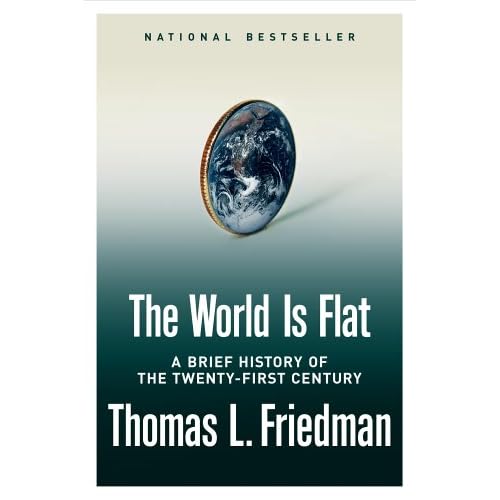
Click on the link below for a powerpoint slide show about Tom Friedman's book,
The World is Flat. My assessment of the book (and his previous book, The Lexus and the Olive Tree) is that he is correct in most things, but far too positive about what globalization is doing to poor people on the ground. But he writes extremely well and has done much to raise these issues to the common person's awareness.

Reversal of Fortune

By Joseph E. Stiglitz

Describing how ideology, special-interest pressure, populist politics, and sheer incompetence have left the US economy on life support, the author puts forth a clear, commonsense plan to reverse the Bush-era follies and regain America’s economic sanity.

When the American economy enters a downturn, you often hear the experts debating whether it is likely to be V-shaped (short and sharp) or U-shaped (longer but milder). Today, the American economy may be entering a downturn that is best described as L-shaped. It is in a very low place indeed, and likely to remain there for some time to come.

Virtually all the indicators look grim. Inflation is running at an annual rate of nearly 6%, its highest level in 17 years. Unemployment stands at 6 percent; there has been no net job growth in the private sector for almost a year. Housing prices have fallen faster than at any time in memory, in Florida and California, by 30% or more. Banks are reporting record losses, only months after their executives walked off with record bonuses as their reward. President Bush inherited a $128 billion budget surplus from Bill Clinton; this year the federal government announced the second-largest budget deficit ever reported. During the eight years of the Bush administration, the national debt has increased by more than 65 percent, to nearly $10 trillion (to which the debts of Freddie Mac and Fannie Mae should now be added, according to the Congressional Budget Office). Meanwhile, we are saddled with the cost of two wars. The price tag for the one in Iraq alone will, by my estimate, ultimately exceed $3 trillion.

This tangled knot of problems will be difficult to unravel. Standard prescriptions call for raising interest rates when confronted with inflation, just as standard prescriptions call for lowering interest rates when confronted with an economic downturn. How do you do both at the same time? Not in the way that some politicians have proposed. With gasoline prices at all-time highs, John McCain has called for a rollback of gas taxes. But that would lead to more gas consumption, raise the price of gas further, increase our dependence on foreign oil, and expand our already massive trade deficit. The expanding deficit would in turn force the US to continue borrowing gargantuan sums from abroad, making us even more indebted. At the same time, the higher imports of oil and petroleum-based products would lead to a weaker dollar, fueling inflationary pressures.

Millions of Americans are losing their homes. This social catastrophe has severe economic effects. The banks and other financial institutions that own these mortgages face stunning reverses. To prevent America’s $5.2 trillion home financiers, Fannie Mae and Freddie Mac, from following suit, Congress authorized a blank check to cover their losses, but even that generosity failed to do the trick. Now the administration has taken over the two entities completely, a stunning feat for a supposedly market-oriented regime. These bailouts contribute to growing deficits in the short run, and to perverse incentives in the long run. Market economies work only when there is a system of accountability, but CEO’s, investors, and creditors are walking away with billions, while American taxpayers are being asked to pick up the tab. We’re looking at a new form of public-private partnership, one in which the public shoulders all the risk, and the private sector gets all the profit. While the Bush administration preaches responsibility, the words are addressed only to the less well-off. The administration talks about the impact of “moral hazard” on the poor “speculator” who borrowed money and bought a house beyond his ability to pay. But moral hazard somehow isn’t an issue when it comes to the high-stakes speculators in corporate boardrooms.

How Did We Get into This Mess?:

A unique combination of ideology, special-interest pressure, populist politics, bad economics, and sheer incompetence has brought us to our present condition. Our economy rests on public investments in technology, such as the Internet. While Bush’s ideology led him to underestimate the importance of government, it also led him to underestimate the limitations of markets. We learned from the Depression that markets are not self-adjusting, at least, not in a time frame that matters to living people. Today everyone, even the president, accepts the need for macro-economic policy, for government to try to maintain the economy at near-full employment. But in a sleight of hand, free-market economists promoted the idea that, once the economy was restored to full employment, markets would always allocate resources efficiently. The best regulation, in their view, was no regulation at all, and if that didn’t sell, then “self-regulation” was almost as good.

We are in the midst of micro-economic failure on a grand scale. Financial markets receive generous compensation, in the form of more than 30% of all corporate profits, presumably for performing two critical tasks: allocating savings and managing risk. But the financial markets have failed laughably at both. Hundreds of billions of dollars were allocated to home loans beyond Americans’ ability to pay. And rather than managing risk, the financial markets created more risk. The failure of our financial system to do what it is supposed to do matches in destructive grandeur the macro-economic failures of the Great Depression.

What Is to Be Done?:

As America attempts to work its way out of the present crisis, the danger is that we will listen to the same people on Wall Street and in the economic establishment who got us into it. For them, our current predicament is another opportunity: if they can shape the government response appropriately, they stand to gain, or at least stand to lose less, and they may be willing to sacrifice the well-being of the economy for their own benefit, just as they did in the past.

There are a number of economic tools at the country’s disposal. As noted, they can yield contradictory results. The sad truth is that we have reached the limits of monetary policy. Lowering interest rates will not stimulate the economy much, banks are not going to be willing to lend to strapped consumers, and consumers are not going to be willing to borrow as they see housing prices continue to fall. And raising interest rates, to combat inflation, won’t have the desired impact either, because the prices that are the main sources of our inflation, for food and energy, are determined in international markets; the chief consequence will be distress for ordinary people. The quandaries that we face mean that careful balancing is required. There is no quick and easy fix. But if we take decisive action today, we can shorten the length of the downturn and reduce its magnitude. If at the same time we think about what would be good for the economy in the long run, we can build a durable foundation for economic health.

We can have a financial system that is more stable, and even more dynamic, with stronger regulation. Self-regulation is an oxymoron. Financial markets produced loans and other products that were so complex and insidious that even their creators did not fully understand them; these products were so irresponsible that analysts called them “toxic.” Yet financial markets failed to create products that would enable ordinary households to face the risks they confront and stay in their homes. We need a financial-products safety commission and a financial-systems stability commission. And they can’t be run by Wall Street. The Federal Reserve Board shares too much of the mindset of those it is supposed to regulate. It could and should have known that something was wrong. It had instruments at its disposal to let the air out of the bubble, or at least ensure that the bubble didn’t over-expand. But it chose to do nothing. What has happened to the American economy was avoidable. It was not just that those who were entrusted to maintain the economy’s safety and soundness failed to do their job. There were also many who benefited handsomely by ensuring that what needed to be done did not get done. Now we face a choice: whether to let our response to the nation’s woes be shaped by those who got us here, or to seize the opportunity for fundamental reforms, striking a new balance between the market and government.

Joseph E. Stiglitz, a Nobel Prize–winning economist, is a professor at Columbia University

Growing Pains: Keeping fair trade fair

Sojourners Magazine

by Patty Kupfer

Ask the nearly 600 members of the CIRSA coffee cooperative in the mountains of Chiapas, Mexico, how things are going and they’ll tell you, “Little by little, we’re moving forward.” Considering that a couple of decades ago the parents of these indigenous farmers worked in slavery-like conditions on large coffee plantations in the region, and that their region has been ignored and marginalized throughout its history, their progress is tremendous.

The Indigenous Communities of the Simojovel de Allende Region (CIRSA in Spanish) shipped 235 tons of fair trade coffee last year to the United States and Europe. Through the fair trade certification system, the small farmers of CIRSA and similar cooperatives throughout Latin Ameri­ca are guaranteed a minimum price for their coffee. This provides stability to small farmers, who live in some of the world’s poor­est regions—and who are especially vulnerable to the volatile market that dictates world coffee prices. This is why, on our weekly trip to the grocery store, many of us fork over some extra change for fair trade coffee.

Twenty years after its birth, the fair trade movement is suffering some growing pains. No longer a fringe movement, fair trade boasted $2.2 billion dollars in global sales during 2006, and debates rage from within about whether rapid expansion may be compromising the movement’s core principles.

One key debate focuses on the difference between small farmer cooperatives and large plantations. Right now, plantations can’t participate in the fair trade coffee market, but recent proposals would change that. In products such as tea and bananas, most fair trade items already come from large plantations, which win certification by ensuring higher wages, increased worker protections and greater social investments than they would otherwise provide. So what’s the problem with plantations?

It’s important to see how fair trade certification fits into the bigger picture of farmers’ struggle for a decent livelihood. Take the example of CIRSA: The coffee farmers of Simojovel de Allende struggled for years to win the land reform that enabled them to become independent smallholders. The plantations where their families had worked were a legacy of the colonial era, when a small elite controlled most political and economic structures, allowing them to sustain miserable working conditions with miniscule chances for upward mobility.

Owning their own land gave the CIRSA farmers the footing to organize as a cooperative in 1992; the higher wage they earn from fair trade certified coffee, in turn, helps them to win the constant struggle to stay organized.

CIRSA’s treasurer, Juan López, states it eloquently: “Alone, you can’t do anything. We’ve joined together to make a better life.” Phyllis Robinson, education and campaigns manager at fair trade vendor Equal Ex-change, agrees that getting organized is critical. “Small farmers in today’s agricultural markets are up against all odds. The higher, more stable price of fair trade helps keep farmers organized in co-ops, where they have an easier time accessing credit or technical capacity building.”

If the Fair Trade Labeling Organization (FLO) were to start certifying coffee plantations—an idea that has been defeated for now, but is sure to rise again—chains like Wal-Mart or Starbucks would likely make their fair trade purchases from the largest producers, to simplify their logistics. Small farmers worry this shift would take them down a slippery slope back to the dominance of the plantation model.

Another concern is whether fair trade is still providing a living wage. In 2007, FLO approved the first increase of its minimum coffee price in 18 years. The increase of five cents per pound of coffee brought the total price to $1.31 (the price for organic fair trade coffee went from $1.41 to $1.51 a pound). While higher market prices in recent years have forced fair trade buyers to pay above the minimum to guarantee their supplies, farmers pointed to increases in labor and transportation costs that still weren’t covered.

Despite the challenges, CIRSA is committed and hopeful about its future in fair trade. Last year the co-op met all its sales goals and had a surplus to sell to the Mexican market. They’ve purchased their own semitrailer for transport. Every year they pick up a dozen or so new members.

In 2004, CIRSA began receiving visits from groups of U.S. consumers. They welcomed the chance to deepen the commitment and awareness between coffee drinkers and producers, recognizing the importance of an international network of consumers who are paying attention. As Robinson points out, fair trade works best not as an end in itself, but as “a window to get you hooked in. It’s not the last thing you do.”


Growing Pains. by Patty Kupfer. Sojourners Magazine, September/October 2008 (Vol. 37, No. 9, pp. 8). Commentary.


Patty Kupfer worked in Mexico from 2003 to 2005 as an international team member for Witness for Peace. She organized for immigration reform when this article appeared.

Jubilee Activities, Books, and Fund Raisers

This edition of the blog is all ads, announcements, and fund raisers. Some will even cost you money. But quit complaining. You know you have to give back every now and then. Life is like that.
--Stan


First, two ads for books.
My apologies that I wrote parts of both of them, but don't hold that against them.

AboveGroundPicFirst, is a new book by Harvard Square Editions, Above Ground: An Anthology of Living Fiction. It's a collection of short stories and novellas all by Harvard graduates. (I contributed a novella.) What makes it worthy of note is that all of the proceeds go to Doctors without Borders and Jubilee USA, which as you probably know I work closely with. In spite of my contribution, it's a good book and you should buy a copy. You can get one by clicking here.


JubileeBookCoverThe second is even more self serving. I've just singed a contact to do a new edition of my book, From Jubilee to the World Bank: Economic Globalization for People of Faith, but if you would like to purchase one of the old(er) versions, some are still available at the same old bloated price, and you can find copies here. (Incidentally, the new title will probably be shortened to just Economic Globalization for Faith-Based Activists). You can order a copy by clicking here.


Speaking of things that are good for you but which will cost you money, here is an event you really ought to go to as a favor to me. Please come if you can:


Wednesday, October 7
7PM – 9 PM
"Common Place"

141 Oxford Street
Cambridge, MA
Just south of Porter Square at the intersection of Oxford and Beacon.
Hosted by Stan Duncan and Devon Davidson

Learn about the critical issues of the debt cancellation work: the bills in congress, the campaigns for fair and just international financing, the dangers of "vulture funds" and how you can help.
Also learn about the coffee you drink from our friends at Equal Exchange:
Ever wonder about the difference between medium and high acidity? What is meant by full body? How can coffee have a citrus note?
Learn how you can be a part of the world's largest international, interfaith economic justice campaign, bringing about a more just and humane planet.

Many of the countries hardest hit by the international debt crisis also suffer from the collapse of coffee prices and free market policies of the 1990s. Our partners from Equal Exchange, the largest and oldest Fair Trade company in the US, will join us and lead a coffee tasting from beans grown in countries needing debt relief. (We’'ll have decaf, too!) Other refreshments will also represent countries whose debt you can help us work to cancel.
For more information (maps, directions, etc.), please contact Devon Davidson (617) 501-3230; devon2020@gmail.com
For more information about the Jubilee USA Network go to
www.jubileeusa.org


Mission and Justice Sunday

October 18, 2009

This year (and this year only) October 18 is a day that we can celebrate Jubilee Sunday, Bread for the World Sunday, and Micah Sunday. More opportunities than ever in one pile to lift up mission and justice themes. The stars will not align like this again for the next three hundred years and you probably won't be around to see it.

Why not make this an opportunity to lift up a our Christian commitment to global Mission and Justice on a wide variety of levels? Hunger, poverty, community and justice, all a part of one Sunday celebration. You can weave elements from each of the themes into a consistent thread of the Christian faith and justice message.

Here are resources for all of them that you can use. Use them all and make this the biggest mission and justice day of the year.


(Finally, ripped off from the macucc.org web page...)


Just PracticeJustPracticeLogo
A New England UCC Justice and Witness event on practicing justice in our lives, communities, and world

Friday, Nov. 6 (5 pm) to Saturday, Nov. 7 (4 pm)
United Congregational Church, UCC
6 Institute Road ~ Worcester, Mass.

So what is this "Just Practice?"
Jesus said "The reign of God is in your midst." (Luke 17:21) So maybe, just maybe, building God's beloved community "just" takes practice, persistent, prayerful - even playful - practice. And really, everything we do is "just practice." We may never get it exactly right, certainly not without the intervention of God's Holy Spirit. Nonetheless, we give it our best shot. We practice. Sometimes we stumble. But we get back up and try again. We pray for the Spirit's participation in our efforts. We keep practicing, together, just because God who loves us calls us to this sacred labor.

Intrigued? Then join us!
Through creative worship, Bible study, shared learning, movement and group reflection, you'll be invited to deepen your own understanding of what "just practice" means to you and your faith community, and to share your insights with others. Together we'll explore what happens when we see, reflect and act on today's reality. We'll add tools for healing to help us live fully into God's call. And then, well, we'll just practice.

Learn more...
Download a flyer with agenda and mail-in registration form here (pdf)

Sponsored by the New England Conferences of the United Church of Christ endorsed by the Commission for Mission & Justice


The Palin Choice: The Reality of the Political Mind

George Lakoff argues that the Republican choice of Palin makes total sense if you truly understand the strategy of the Republicans in this election.
From Tikkun Magazine (www.tikkun.org)
September 04 2008

by George Lakoff

This election matters because of realities-the realities of global warming, the economy, the Middle East, nuclear proliferation, civil liberties, species extinction, poverty here and around the world, and on and on. Such realities are what make this election so very crucial, and how to deal with them is the substance of the Democratic platform .

Election campaigns matter because who gets elected can change reality. But election campaigns are primarily about the realities of voters' minds, which depend on how the candidates and the external realities are cognitively framed. They can be framed honestly or deceptively, effectively or clumsily. And they are always framed from the perspective of a worldview.

The Obama campaign has learned this. The Republicans have long known it, and the choice of Sarah Palin as their Vice-Presidential candidate reflects their expert understanding of the political mind and political marketing. Democrats who simply belittle the Palin choice are courting disaster. It must be t aken with the utmost seriousness.

The Democratic responses so far reflect external realities: she is inexperienced, knowing little or nothing about foreign policy or national issues; she is really an anti-feminist, wanting the government to enter women's lives to block abortion, but not wanting the government to guarantee equal pay for equal work, or provide adequate child health coverage, or child care, or early childhood education; she shills for the oil and gas industry on drilling; she denies the scientific truths of global warming and evolution; she misuses her political authority; she opposes sex education and her daughter is pregnant; and, rather than being a maverick, she is on the whole a radical right-wing ideologue.

All true, so far as we can tell.

But such truths may nonetheless be largely irrelevant to this campaign. That is the lesson Democrats must learn. They must learn the reality of the political mind.

The Obama campaign has done this very well so far. The convention events and speeches were orchestrated both to cast light on external realities, traditional political themes, and to focus on values at once classically American and progressive: empathy, responsibility both for oneself and others, and aspiration to make things better both for oneself and the world. Obama did all this masterfully in his nomination speech, while replying to, and undercutting, the main Republican attacks.

But the Palin nomination changes the game. The initial response has been to try to keep the focus on external realities, the "issues," and differences on the issues. But the Palin nomination is not basically about external realities and what Democrats call "issues," but about the symbolic mechanisms of the political mind-the worldviews, frames, metaphors, cultural narratives, and stereotypes. The Republicans can't win on realities. Her job is to speak the language of conservatism, activate the conservative view of the world, and use the advantages that conservatives have in dominating political discourse.

Our national political dialogue is fundamentally metaphorical, with family values at the center of our discourse. There is a reason why Obama and Biden spoke so much about the family, the nurturant family, with caring fathers and the family values that Obama put front and center in his Father's day speech: empathy, responsibility and aspiration. Obama's reference in the nomination speech to "The American Family" was hardly accidental, nor were the references to the Obama and Biden families as living and fulfilling the American Dream. Real nurturance requires strength and toughness, which Obama displayed in body language and voice in his responses to McCain. The strength of the Obama campaign has been the seamless marriage of reality and symbolic thought.

The Republican strength has been mostly symbolic. The McCain campaign is well aware of how Reagan and W won-running on character: values, communicatio n, (apparent) authenticity, trust, and identity - not issues and policies. That is how campaigns work, and symbolism is central.

Conservative family values are strict and apply via metaphorical thought to the nation: good vs. evil, authority, the use of force, toughness and discipline, individual (versus social) responsibility, and tough love. Hence, social programs are immoral because they violate discipline and individual responsibility. Guns and the military show force and discipline. Man is above nature; hence no serious environmentalism. The market is the ultimate financial authority, requiring market discipline. In foreign policy, strength is use of the force. In fundamentalist religion, the Bible is the ultimate authority; hence no gay marriage. Such values are at the heart of radical conservatism. This is how John McCain was raised and how he plans to govern. And it is what he shares with Sarah Palin.

Palin is the mom in the strict father family, upholding conservative values. Palin is tough: she shoots, skins, and eats caribou. She is disciplined: raising five kids with a major career. She lives her values: she has a Downs-syndrome baby that she refused to abort. She has the image of the ideal conservative mom: pretty, perky, feminine, Bible-toting, and fitting into the ideal conservative family. And she fits the stereotype of America as small-town America. It is Reagan's morning-in-America image. Where Obama thought of capturing the West, she is running for Sweetheart of the West.

And Palin, a member of Feminists For Life, is at the heart of the conservative feminist movement, which Ronee Schreiber has written about in her recent book, Righting Feminism. It is a powerful and growing movement that Democrats have barely paid attention to.
At the same time, Palin is masterful at the Republican game of taking the Democrats' language and reframing it-putting conservative frames to progressive words: Reform, prosperity, peace. She is also masterful at using the progressive narratives: she's from the working class, working her way up from hockey mom and the PTA to Mayor, Governor, and VP candidate. Her husband is a union member. She can say to the conservative populists that she is one of them-all the things that Obama and Biden have been saying. Bottom-up, not top-down.

Yes, the McCain-Palin ticket is weak on the major realities. But it is strong on the symbolic dimension of politics that Republicans are so good at marketing. Just arguing the realities, the issues, the hard truths should be enough in times this bad, but the political mind and its response to symbolism cannot be ignored. The initial Democratic response to Palin - the response based on realities alone - indicates that many Democrats have not learned the lessons of the Reagan and Bush years.

They have not learned the nature of conservative populism. A great many working-class folks are what I call "bi-conceptual," that is, they are split between conservative and progressive modes of thought. Conservative on patriotism and certain social and family issues, which they have been led to see as "moral", progressive in loving the land, living in communities of care, and practical kitchen table issues like mortgages, health care, wages, retirement, and so on.
Conservative theorists won them over in two ways: Inventing and promulgating the idea of "liberal elite" and focusing campaigns on social and family issues. They have been doing this for many years and have changed a lot of brains through repetition. Palin will appeal strongly to conservative populists, attacking Obama and Biden as pointy-headed, tax-and-spend, latte liberals. The tactic is to divert attention from difficult realities to powerful symbolism.

What Democrats have shied away from is a frontal attack on radical conservatism itself as an un-American and harmful ideology. I think Obama is right when he says that America is based on people caring about each other and working together for a better future-empathy, responsibility (both personal and social), and aspiration. These lead to a concept of government based on protection (environmental, consumer, worker, health care, and retirement protection) and empowerment (through infrastructure, public education, the banking system, the stock market, and the courts). Nobody can achieve the American Dream or live an American lifestyle without protection and empowerment by the government.20The alternative, as Obama said in his nomination speech, is being on your own, with no one caring for anybody else, with force as a first resort in foreign affairs, with threatened civil liberties and a right-wing government making your most important decisions for you. That is not what American democracy has ever been about.

What is at stake in this election are our ideals and our view of the future, as well as current realities. The Palin choice brings both front and center. Democrats, being Democrats, will mostly talk about the realities nonstop without paying attention to the dimensions of values and symbolism. Democrats, in addition, need to call an extremist an extremist: to shine a light on the shared anti-democratic ideology of McCain and Palin, the same ideology shared by Bush and Cheney. They share values antithetical to our democracy. That needs to be said loud and clear, if not by the Obama campaign itself, then by the rest of us who share democratic American values.

Our job is to bring external realities together with the reality of the political mind. Don't ignore the cognitive dimension. It is through cultural narratives, metaphors, and frames that we understand and express our ideals.

George Lakoff is the author of The Political Mind: Why You Can't Understand 20th Century Politics With an 18th Century Brain

ref: http://files.tikkun.org/current/article.php?story=20080904070242463